


The Revenue Hiding in Plain Sight
Insights from 27 MSP operators, coaches, and advisers on the growth most owners miss.
Contents
- Foreword Victor Raessen, CEO, Salesbuildr
- The MSP Growth Lie Your existing base is probably half-unpenetrated. You're spending money hunting for revenue that's already there.
- Seeing the Opportunity You're Missing. You can't grow what you can't see. And right now, most of the opportunity in your client base is invisible.
- Why You Undercharge The MSPs charging the most also sell the most. The relationship between price and growth runs in the opposite direction.
- Why Bespoke Kills Margins Custom everything feels like good service. It's actually the thing stopping your business from scaling.
- Account Management as a Growth Engine Most account managers are paid to maintain relationships. The ones driving growth are paid to have conversations that create revenue.
- How to Read Your Data Most MSPs have more data than they know what to do with. The problem has never been access.
- How Culture Unlocks Expansion Your best salespeople already work for you. They just don't know they're selling.
- Building an MSP That Runs Without You The business grows faster the moment you stop being essential to it.
- Your 90-Day Plan The gap between knowing what to do and doing it is where most business books go to die.
FOREWORD
Victor Raessen, CEO, Salesbuildr
Victor Raessen - CEO, Salesbuildr
Victor Raessen
CEO and Founder, Salesbuildr Built and ran an MSP for seven years. Worked with hundreds of MSPs across Europe at Autotask and Datto. Now building the sales system he wishes he’d had.
I ran an MSP for seven years. I know what it feels like to sit across from a client and wonder whether you are charging enough.
I know the Sunday evening feeling of looking at the week ahead and realising you are the bottleneck in every conversation that matters. And I know what happens when you finally look at the data instead of guessing: you find an opportunity you did not know was there.
After selling my MSP, I spent years working for MSPs and at Autotask and then Datto, working with hundreds of managed service providers across Europe. The pattern was remarkably consistent.
Technically excellent businesses. Strong client relationships. And almost without exception, a sales process that existed mostly in the owner’s head.
The tools were there. The data was there. The willingness was there. What was missing was a system.
That observation is what led me to build Salesbuildr. But this book is not about Salesbuildr. This book is about the thinking underneath it - the principles that make the difference between an MSP that grows and one that stays the same size year after year while working harder.
“I first met James Steel when he joined us as Channel Chief. He has an unusual combination: deep channel experience, genuine curiosity about how MSPs actually operate, and an ability to get people talking honestly about what is and is not working.”
VICTOR RAESSEN
James Steel
Host, Harvest! The MSP Sales Show 15+ years in the MSP channel. Founder of Digital Steel and MSP Testimonials. Interviewed every guest in this book.
When he launched the Harvest podcast, I watched 27 episodes’ worth of MSP leaders share things they do not normally say out loud, pricing mistakes, delegation failures, and the clients they should have let go years ago.
This book distils those conversations into something practical: specific frameworks from people who have done the work and are willing to tell you what it actually costs them.
50%
Average MSP penetration into their existing client base
MSP leaders whose insights shaped this book 7+ Years running an MSP before
building Salesbuildr
Most MSPs are sitting on more untapped revenue than they realise. The average MSP is perhaps 50% penetrated into their existing client base. The gap is one of visibility, not ambition. You cannot sell what you cannot see.
Pricing is a confidence problem, not a market problem. The MSPs who charge the most also grow the fastest. Higher prices fund better service, better service earns deeper trust, and deeper trust opens more conversations. It is a cycle, and it runs in both directions.
Standardisation is not the enemy of good service. It is the foundation of it. MSPs supporting four different endpoint tools, three backup platforms, and a handful of configurations nobody fully understands are not being flexible - they are being inefficient.
Sales is not a dirty word. Many MSP owners started as engineers. The commercial side came later, reluctantly, and often without any structure at all. This book treats sales as what it is: a professional discipline that deserves the same rigour you apply to your service delivery.
Every MSP in this book started the same way: a single afternoon, one thing tried, one thing measured. Not a transformation programme, a small experiment that revealed something they didn’t already know about their own business.
Pick a chapter, and start this afternoon.
CHAPTER ONE The MSP Growth Lie. Your existing base is probably half-unpenetrated. You're spending money hunting for revenue that's already there.
The MSP Growth Lie
It’s Thursday afternoon. You’re reviewing a proposal for a prospect you’ve been courting for six months - and you already know you’ll discount it to close. Meanwhile, three floors up at a client you’ve had for four years, someone is Googling “managed security provider” because nobody from your team has mentioned it.
Two growth opportunities: • One’s costing you margin.
• The other’s been sitting there the whole time.
Nigel Moore, Ep 1
The Tech Tribe · Former MSP owner, Sydney The wildly unconfident scared nerdy guy who built a client service matrix and changed his role forever.
Nigel Moore owned an MSP in Sydney from 2007. For the first few years, it was the usual story: long hours, modest take-home, chasing every prospect.
By his own admission, he was “the wildly unconfident scared nerdy guy that would literally ask them about what antivirus tool they’re running.” He couldn’t imagine asking clients about their profit margins or business plans.
One afternoon, he opened Excel and did something disarmingly simple. He listed every client down the left side and every service across the top.
Traffic light colours: • green for services a client already had • orange for services they could benefit from • red for things that would never apply “Our whole goal was to paint that spreadsheet green. But there was always a pile of orange, and that pile of orange is our opportunity to go deep into our existing clients.”
NIGEL MOORE - FORMER MSP OWNER, SYDNEY
Nigel's traffic-light matrix: green for services a client has, orange for the gap, red for the things that won't apply. More orange than he expected. Clients he’d worked with for years were missing services he’d assumed they had.
He saw MSPs around him doing the same thing: spending money on marketing campaigns, business cards for dance studio lobbies, every networking event going, while sitting on untapped potential in their existing base.
He decided to stop chasing new logos for six months and focus entirely on filling in those orange cells.
Within three months, revenue was growing faster than when his team was hunting. Margins improved because they weren’t discounting to close. And clients responded well. They felt like his team had started paying proper attention to their needs.
Over time, Nigel’s own role transformed. He went from the nervous IT guy to someone with “a spot at the C-suite table, essentially the CTO, making the budgetary decisions for them around IT.” That shift didn’t come from a clever sales technique. It came from investing in relationships he’d already built.
What’s worth noting is how he did it. Excel. One person, eyeballing a spreadsheet, manually colour-coding cells. It worked brilliantly at his scale. But across 80 clients and 15 services, that’s 1,200 cells to populate, maintain, and act on. The data to fill those cells exists in your PSA, service agreements, billing records, and ticket history, but it’s scattered. There’s no single view showing gaps across the entire estate.
The exercise is brilliant. The execution is what doesn’t stick.
Most MSPs who try the spreadsheet exercise build the matrix once, get excited, then never update it. Because it’s manual. Because it takes half a day. Because it’s already drifting out of date by the time you finish. The insight is sound.
The execution doesn’t stick. Not because people lack discipline, but because the approach demands ongoing effort that competes with everything else on the plate.
The pull of the new logo
None of this is news to experienced MSP leaders. You know expansion is more efficient than acquisition. You’ve seen the logic. But the pull toward hunting is strong, and it’s worth understanding why.
New logos are visible. You can point to them in board meetings. They feel like progress.
Client expansion, even when it’s far more profitable, feels operational. It looks like account management, and it simply doesn’t generate the same buzz.
There’s also a structural issue. Most MSPs track pipeline for new business meticulously: CRM stages, proposal tracking, win/loss ratios. But expansion opportunities within existing accounts? Often, they live in account managers’ heads, or in notes from the last check-in call that nobody followed up on.
There’s no pipeline for it. No scoring. No systematic way to surface which accounts have the biggest gaps and which conversations should happen first.
The Inertia Problem
Paul Green, Ep 9
MSP Marketing Edge · Founder, UK In the channel since 2016. Coined "inertia loyalty", the reason your clients are with you, not your service.
Paul Green runs MSP Marketing Edge and has worked within the channel since 2016. He identified something that’s worth sitting with for a moment.
“The vast majority of MSPs assume that’s because they’re doing a really good job for their clients,” Paul said, talking about high retention rates. “But actually, I believe, maybe controversially, that the reason most MSPs have great retention is because of something called inertia loyalty.” The same force that keeps you with your bank even though you’d never recommend them. Switching is a hassle, so you stay.
Some of your clients might feel the same way. That’s not necessarily a crisis.
Inertia loyalty is still loyalty, in practice. But it’s fragile. One competitor with a sharper proposition, one security incident handled badly, one budget review where your invoice gets questioned, and that “loyal” client starts taking meetings.
“The MSPs with the strongest client bonds aren’t the passive ones. They’re the ones continuously expanding. Because expansion done well doesn’t feel like being sold to. It feels like being looked after.”
PAUL GREEN - MSP MARKETING EDGE
The expansion path isn’t a backup. It’s the most efficient growth your business will ever do.
Where the top MSPs are actually growing
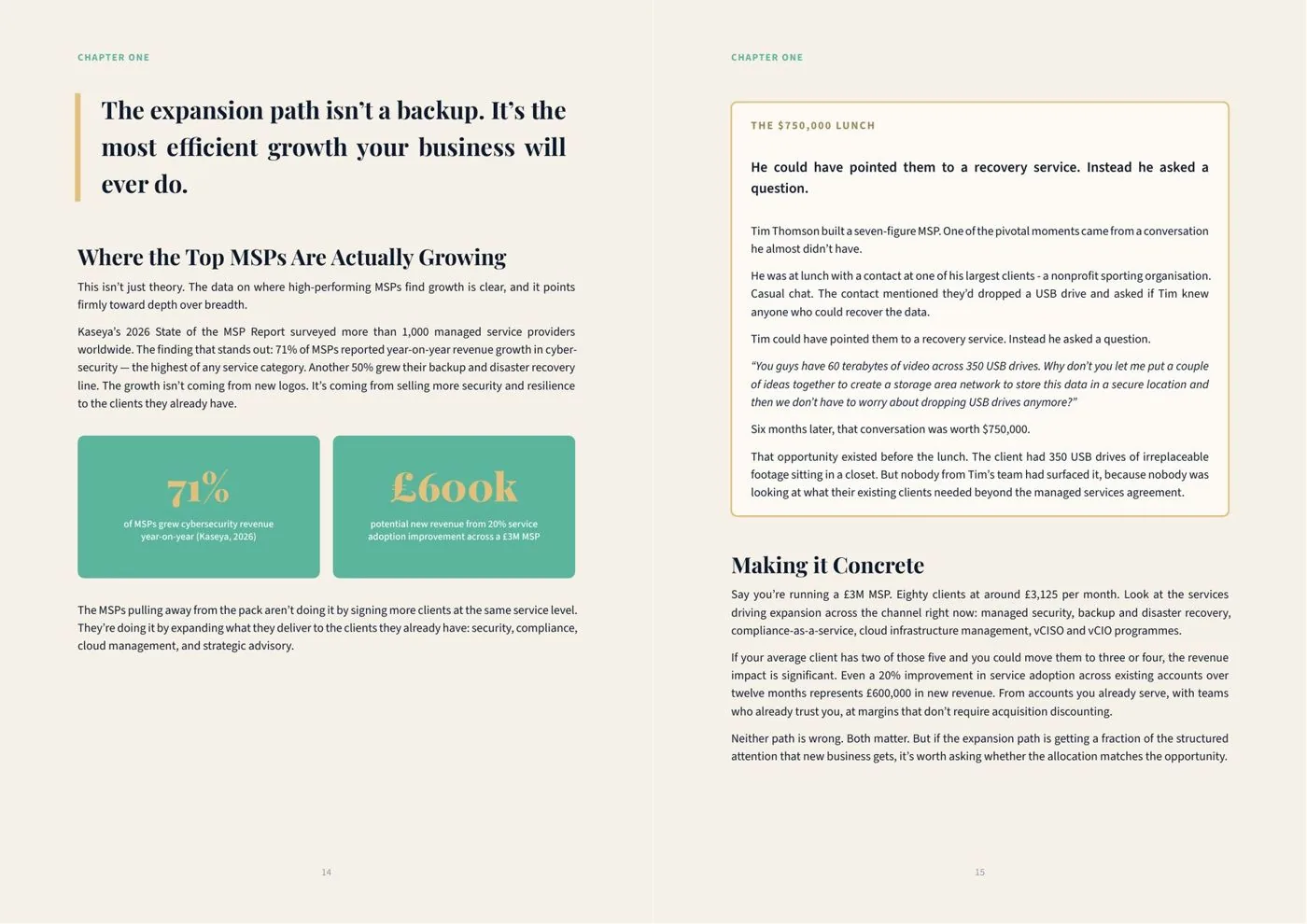
This isn’t just theory. The data on where high-performing MSPs find growth is clear, and it points firmly toward depth over breadth.
Kaseya’s 2026 State of the MSP Report surveyed more than 1,000 managed service providers worldwide. The finding that stands out: 71% of MSPs reported year-on-year revenue growth in cybersecurity, the highest of any service category. Another 50% grew their backup and disaster recovery line. The growth isn’t coming from new logos. It’s coming from selling more security and resilience to the clients they already have.
71% of MSPs grew cybersecurity revenue year-on-year (Kaseya, 2026) £600k potential new revenue from 20% service adoption improvement across a £3M MSP The MSPs pulling away from the pack aren’t doing it by signing more clients at the same service level.
They’re doing it by expanding what they deliver to the clients they already have: security, compliance, cloud management, and strategic advisory.
He could have pointed them to a recovery service. Instead he asked a question.
Tim Thomson built a seven-figure MSP. One of the pivotal moments came from a conversation he almost didn’t have.
He was at lunch with a contact at one of his largest clients - a nonprofit sporting organisation.
Casual chat. The contact mentioned they’d dropped a USB drive and asked if Tim knew anyone who could recover the data.
Tim could have pointed them to a recovery service. Instead he asked a question.
“You guys have 60 terabytes of video across 350 USB drives. Why don’t you let me put a couple of ideas together to create a storage area network to store this data in a secure location and then we don’t have to worry about dropping USB drives anymore?” Six months later, that conversation was worth $750,000.
That opportunity existed before the lunch. The client had 350 USB drives of irreplaceable footage sitting in a closet. But nobody from Tim’s team had surfaced it, because nobody was looking at what their existing clients needed beyond the managed services agreement.
Making it concrete. Say you’re running a £3M MSP. Eighty clients at around £3,125 per month. Look at the services driving expansion across the channel right now: managed security, backup and disaster recovery, compliance-as-a-service, cloud infrastructure management, vCISO and vCIO programmes.
If your average client has two of those five and you could move them to three or four, the revenue impact is significant. Even a 20% improvement in service adoption across existing accounts over twelve months represents £600,000 in new revenue. From accounts you already serve, with teams who already trust you, at margins that don’t require acquisition discounting.
Neither path is wrong. Both matter. But if the expansion path is getting a fraction of the structured attention that new business gets, it’s worth asking whether the allocation matches the opportunity.
Nigel Moore
The Tech Tribe - Former MSP owner, Sydney (2007-2016) | Episode 1
Tim Thomson Former MSP owner, seven-figure business builder | Episode 17
Paul Green MSP Marketing Edge - UK-based, channel marketing since 2016 | Episode 9
Seeing the Opportunity You're Missing. You can't grow what you can't see. And right now, most of the opportunity in your client base is invisible.
Seeing the Opportunity You’re Missing
You’re in a quarterly review with one of your longest-standing clients. Six years together. You know their environment inside out - the quirky printer on the second floor, the CFO who refuses to upgrade his laptop, the time you saved them during that ransomware scare. Then someone mentions over coffee that they’ve just signed a security awareness contract. With another provider. Nobody told you. Nobody asked.
The relationship wasn’t bad. Nobody had looked.
Chapter 1 made the case that your existing base is probably half-unpenetrated. Nigel Moore proved it in an afternoon with a spreadsheet. But an afternoon’s insight has a shelf life. The method doesn’t scale. This chapter is about what does - frameworks that make the invisible visible, and systems that keep it that way.
Paul Lloyd, Ep 27
Sellerly · Sales strategy and management
30 years in technology sales. Coaches MSPs on their existing accounts before he touches their pipeline.
Paul Lloyd has spent 30 years in technology sales, managing teams of four to ninety across multiple branches. He now works directly with MSPs on their sales strategy. When he sits down with a new client, the first thing he asks about isn’t their pipeline or their marketing. It’s their existing accounts.
And the first thing he hears is confidence.
“I got one guy a couple of years ago,” Paul said. “He insisted every one of his accounts were covered and he didn’t need to do it. So he wasn’t going to do his white space.” Paul couldn’t make him. So he left it alone.
A fortnight later, the phone rang.
The MSP owner had 34 services rolled into packages. Forty accounts. Every single one had the first four services. Every one. And the rest?
“An ocean of blank cells.”
Forty accounts. Thirty services they weren’t buying. Nobody had even offered them. The guy who was certain he had everything covered was sitting on more untouched opportunity than most MSPs generate in a year of hunting.
“An ocean of blank cells.” PAUL LLOYD - SELLERLY, ON WHAT AN MSP FOUND WHEN TH EY FINALLY RAN THE ANALYSIS THEY
The Blank Cell Problem
That gap - between what you think you know about your accounts and what the data actually shows is worth naming. Call it the Blank Cell Problem.
Familiarity breeds assumption. You talk to your clients regularly. You solve their problems. You know their names, their quirks, their office layout. And precisely because the relationship feels close, you assume the commercial picture is complete. Most MSPs who sit down with Paul say the same thing: we’ve got it covered. Most of them are wrong.
“A 50-seat company will spend a quarter of a million pounds a year on IT,” Paul said. “So if I’ve got a 50-seat customer and they’re spending 20 grand with me, then there’s £230,000 going somewhere.” Eight percent of the budget. Someone else has the other ninety-two. And unlike a cold prospect, you already have the trust, the access, and the track record. You just haven’t had the conversation.
The moment you see what was already there. What makes the Blank Cell Problem deceptively hard to solve is that the exercise itself takes an afternoon, but the decay starts immediately. Most MSPs who build the matrix get a burst of energy they see the gaps, pick up the phone, close a few quick wins (the low-hanging fruit that’s been dangling so long it’s practically composting). Then the spreadsheet sits untouched for six months because nobody owns the follow-up. There’s no cadence for turning blank cells into conversations, or conversations into revenue.
If you’ve tried this before and it fizzled, you’re in good company.
Paul’s approach builds something more durable. He takes the white space data and rolls it up by product category. If fifteen of your forty clients don’t have a phone system with you, that’s not fifteen separate conversations. It’s a campaign.
“If you say to a vendor, ‘I’ve got 15 opportunities, we’d like to close 10 of them, what can you do to sort it?‘ - they’ll be banging on your door,” Paul said. “Because they’ve got so many people telling them absolute nonsense. Anyone with a real plan stands out.” That reframe matters. You’re not chasing individual upsells. You’re running targeted campaigns against your own base, with vendor support, across a defined timeline. First quarter, phone systems.
Second quarter, security. Third quarter, compliance. Each one backed by real data showing exactly which clients have the gap. This is the kind of structured, campaign-based approach that separates
MSPs who grow consistently from those who grow in fits and wonder where the momentum went. We’ll come back to why standardising the offering matters so much in Chapter 4. It takes time, though. Paul’s experience is that a proper sales process needs about six months to bed in. “The first two months they think you’re joking,” he said. Then they push back because “their customers don’t want that type of arrangement.” Only after that resistance breaks does the pipeline start producing.
Six months. Not six days. Anyone selling you a faster transformation is probably selling you something else too.
Your tickets are telling you something
Brian Gillette, Ep 8
Feel-Good MSP · Founder, MSP Sales Podcast host Grew an MSP from $700k to $2M+ ARR by reading the data already sitting in his PSA.
Brian Gillette took over sales at a Southern California MSP doing around $700,000 in annual recurring revenue across roughly 40 clients. No marketing budget to speak of. Rather than hunting for new logos, he turned to the data they already had.
Specifically, the service desk.
“Your tickets are liquid gold,” Brian said. “That information is super valuable to find friction points.” The metric Brian uses is straightforward: Tickets Per User, or TPU. Total monthly tickets divided by users supported, measured at the client level. When a client’s TPU spikes above your baseline, something’s wrong in their environment, usually aging hardware, misconfigured tools, or an infrastructure problem nobody’s surfaced yet.
High TPU isn’t just an operations headache. It’s a revenue signal.
Brian’s team noticed that computers past five years old were considerably more likely to suffer hard drive or power supply failures. Critical tickets. Disruption. Unhappy clients - regardless of how well the MSP responded. So they started tracking device age across the estate and reaching out before things broke.
“Send an email out that says ‘Happy Birthday’ in the subject line,” Brian said. “The body says ‘Happy Birthday to the computer. It’s about to turn five. In human years that’s kindergarten. In computer years, it’s going into the old folks’ home.‘“
Charming? Slightly. But it reframes a hardware refresh from “we think you should spend money” to “we’re looking out for you.” The client feels cared for. The MSP captures a project. Ticket volume drops.
Brian also dedicated an account manager specifically to running quarterly business reviews, not as a formality, but with a revenue quota attached. That single role added $12,000 to $15,000 in new monthly recurring revenue per year, purely from structured expansion conversations with clients the MSP already had. Within a few years, the business grew from $700,000 to over $2 million ARR without trade shows or ad spend, just by working the opportunity already sitting in their existing base.
You might be thinking: we already look at our tickets. Maybe you do. But Brian’s point is sharper than that. Most MSPs use ticket data to measure response times and SLA compliance, both operational metrics, very few read it as a sales tool. The data you need to find expansion revenue is almost certainly already in your PSA: ticket trends, device inventories, contract renewal dates, service adoption by client. All sitting there waiting. The problem (which we’ll unpack properly in Chapter 6) is that nobody’s reading it with commercial eyes.
73% of small businesses aren't confident their MSP can defend them in a cyber attack $2M+
ARR grown from $700k by reading the data already in the PSA Even though over half of those small businesses now rank cybersecurity as their top priority. Your clients already know they need more. They’re just not hearing it from you. (Source: ConnectWise,
State of SMB Cybersecurity 2025.) The data you need to find expansion revenue is almost certainly already in your PSA. Nobody’s reading it with commercial eyes.
Different clients, different conversations
Maria Armstrong, Ep 7
Former Head of Pax8 Academy APAC Worked with hundreds of MSPs across APAC. First MSP outreach round hit 100% success rate.
Maria Armstrong worked with hundreds of MSPs across the APAC region as head of Pax8 Academy before the programme was restructured in late 2024. She saw the same pattern everywhere: MSP owners confident they knew their accounts, and data that said otherwise.
“I was informed before the analysis was done that of course everybody had all the products,” Maria said. “And then once the analysis was done, most customers were missing at least two or three items.” Sound familiar? Paul Lloyd’s client said the same thing. So did half the MSPs in Chapter 1. There’s something about running an MSP that breeds this specific blind spot - the conviction that because you talk to your clients regularly, you must know what they need. You probably do know what they need. You just haven’t asked recently enough.
What Maria did after the white space reveal was different from Paul’s campaign approach, and it’s worth noting because it speaks to something most MSPs overlook entirely: not all clients respond to the same message. She segmented her base into risk-averse and growth-focused camps, then tailored the conversation accordingly.
A risk-averse client needs the security conversation framed around protection and compliance. A growth-focused client needs it framed around competitive advantage and efficiency. Same service.
Different entry point. Most MSPs run a single pitch and wonder why it lands with some clients and bounces off others.
Then the MSP started contacting every single client - either to increase prices where needed or to sell services the analysis had revealed as gaps.
“At this stage, 100% success rate.” That number probably won’t hold forever. Scaling introduces friction, and not every client conversation ends in a yes. But it makes a point worth sitting with. When you combine clear data on what’s missing with an understanding of how each client thinks, you’re not really selling. You’re showing someone something they didn’t know they needed, from a position of trust they’ve already granted you.
The pricing conversations that come out of this work - asking clients to spend more, adjusting rates that have been static for years - are where many MSPs stall. Seeing the gaps is one thing. Having the
confidence to hold your price when filling them is another entirely, and it’s what Chapter 3 tackles head-on. “The myth I’d like to dispel is you can only grow your business through new customer acquisition.
It’s a load of rubbish.” MARIA ARMSTRONG - FORMER HEAD OF PAX8 ACADEMY APAC
The system, not the snapshot Here’s where the real separation happens. Most owners, once they look, can see the opportunity perfectly well. The separation is between the ones who act on it once and the ones who build something that keeps acting on it.
Paul Lloyd’s approach puts every white space opportunity into a pipeline at stage one - raw, unqualified, but tracked. “I want to track every opportunity that comes into the company however thin,” Paul said. Nothing gets lost because nothing lives in somebody’s head. Brian Gillette tracks TPU monthly.
Maria Armstrong ties the analysis to an opportunities board the whole team can see - “not just the sales team, the service manager, the project manager.” What these approaches share is cadence: monthly reviews of the top expansion opportunities, quarterly client conversations informed by actual gap data, vendor campaigns built around clustered white space. The sophistication is in the discipline, not the software.
But someone has to own it. If white space analysis is everyone’s job, it’s nobody’s job. Look at your calendar from last month. How many hours went to structured expansion conversations versus everything else? If the answer stings, that’s useful information.
It’s Monday morning. Your sales meeting opens with the white space dashboard - fifteen accounts flagged as missing security awareness. The team picks five with the strongest relationships and books conversations for this week. By Wednesday, two have turned into scoping calls. The other three weren’t ready, but they know you offer it now. Your service desk lead flags a hardware refresh opportunity spotted through ticket data. It goes on the board. Next month the dashboard updates and the cycle repeats. Nobody had to remember anything. The system remembered for them.
Pick one service you offer that fewer than half your clients currently buy. Security awareness, backup, compliance - whatever has the widest gap.
Build a list: every client who doesn’t have it, with a one-line note on why they should. Then pick five where you have the strongest relationship and book a conversation this week. Not a sales call. A question: “We noticed you don’t have X with us. Is there a reason, or has it just never come up?” Paul Lloyd’s sceptical client found thirty services worth of untouched opportunity across forty accounts. Brian Gillette turned basic ticket data into millions in growth. Maria Armstrong’s MSP hit a 100% success rate on their first round of outreach.
The opportunity is almost certainly there. One afternoon to find it. One conversation to start.
Paul Lloyd
Sellerly - Sales strategy and management, 30 years in tech sales | Episode 27
Brian Gillette Feel-Good MSP - Grew MSP from $700k to $2M+ ARR | Episode 8
Maria Armstrong Former Head of Pax8 Academy APAC - MSP portfolio strategy | Episode 7
CHAPTER THREE Why You Undercharge. The MSPs charging the most also sell the most. The relationship between price and growth runs in the opposite direction.
Why You Undercharge
It’s Tuesday morning. You’re reviewing a proposal for a client you’ve supported for three years security, backup, the full stack - and you’re about to send it at the same rate you quoted in 2021. Somewhere in the back of your mind, you know it should be higher. You send it anyway.
Every expansion conversation, sooner or later, becomes a pricing conversation. And that’s where most MSPs quietly lose.
Joe Rojas, Ep 15
Start Grow Manage · MSP coach Built and sold multiple MSPs. Doubled a client's revenue in a single day with a 100% price increase.
Joe Rojas has built and sold multiple MSPs. He now runs Start Grow Manage, coaching MSP owners through the transition most of them avoid: from technician who happens to own a business to CEO who happens to know technology. When a new client joins his programme, the first thing he tackles isn’t sales or marketing or pipeline building.
It’s pricing.
“Everybody wants to go out and get new clients first,” Joe said. “Wrong place to start. First, you go harvest what you’ve already grown.” And the first harvest? Making sure you’re charging what the work is actually worth.
One of Joe’s clients came to him running an MSP with 88 customers. Decent operation. Reasonable service. Drastically underpriced. Joe looked at the numbers, compared them against industry benchmarks, and told the owner he needed a 100% price increase.
The response was immediate: “I’m going to lose all of my clients.” Joe’s answer: “No, you’re not. You’re going to lose some clients, but not all of your clients.” They didn’t rush it. The strategy took six months. First, two months of intensive service improvement fixing things that had been left, tightening processes, raising the actual quality of delivery. Then the strategic business reviews started. In every conversation, the owner showed clients what hadn’t been working, what had been improved, and what was coming next. The price increase was communicated clearly, with months of lead time. Clients were told they’d be getting a better deal than new customers coming in at the higher rate.
Then they pulled the trigger. “He had 88 clients. A whopping four of them left. And he doubled his revenue in one day.”
Four out of eighty-eight. A 95% retention rate through a 100% price increase. The owner who was convinced he’d lose everyone kept almost all of them. And the four who left? Almost certainly the ones who valued the MSP least to begin with.
Not every MSP can double their prices overnight. Context matters, and your situation may be different. But the story reveals something important about the gap between how MSP owners think about pricing and how their clients actually respond to it.
The confidence gap Most undercharging isn’t a market problem. It’s a confidence problem.
Dan Scott, Ep 3
IT Nation Evolve · Director, 13+ years MSP "There is no sin in being a profitable and growing organisation. " Coaches MSPs out of the discount reflex.
Dan Scott directs IT Nation’s peer groups in Europe and has over thirteen years of hands-on MSP experience. He asks audiences a simple question: how many of you have clients who’ve been with you longer than five years and are still paying what they paid five years ago?
“Sadly I would imagine about 10%, probably nearer to 20% of the audience has still got their hand up,” Dan said.
Five years. During which your costs have risen, your team’s skills have improved, your tools have become more sophisticated, and the threat landscape has got considerably more complex. But the price hasn’t moved.
Because the conversation feels awful. Dan’s honest about that: “Price increases are scary. It just is.
You’ve left it too long. It won’t get any easier the longer you leave it.”
But he reframes the situation in a way that deserves quoting directly: “There is no sin in being a profitable and growing organisation. Your client should want to do business with a healthy company whose team members want to be there.”
That isn’t a sales technique. It’s a statement of fact. Clients benefit from working with profitable MSPs. Profitable MSPs invest in their teams, maintain certifications, keep tools current, and don’t cut corners when margins get tight. An underpaid MSP is a risk to its own clients, even if neither party wants to admit it.
Dan uses a comparison that tends to land: “If your lawyer wakes up and thinks about you at half 3 in the morning, they’ll bill you 30 minutes. If you so much as cross their mind when they can’t sleep, they’ll bill you in the morning.” Nobody questions their solicitor’s rates. Or their accountant’s. Professional services firms price for value and charge with confidence. MSPs, for some reason, often don’t.
The courage to put a confident number on what you sell.
The Discount Reflex There’s a pattern worth naming. Call it the Discount Reflex - that instinct to lower your price before the client has even asked you to.
You’ve seen it. A proposal goes out and you pre-emptively soften it. You round down instead of up.
You throw in a service for free because the total feels too high. Or you absorb a vendor price increase to “protect” the client from a cost that isn’t yours to absorb.
Dan Scott sees MSPs who swallowed Microsoft 365 price increases rather than passing them through.
His take is blunt: “It’s not your fault, it’s not of your making, and it shouldn’t be a reason why you have to sacrifice within your business.” The Discount Reflex rarely comes from the client. It comes from the owner. The fear of confrontation, the discomfort around money, the assumption that a cheaper price is what keeps the relationship safe. It’s psychological, not commercial. And it compounds. Every time you discount without being asked, you’re telling yourself - and your team - that your time is negotiable.
Juan Fernandez, Ep 6
MSP Growth Coalition · Co-founder & CEO Built his second MSP on a bar napkin. Hit $20M across sixteen locations by starting with profit, not services.
Juan Fernandez built an MSP from nothing to $20 million in revenue across sixteen locations. When clients pushed back on his pricing, he had a response he used every time.
“If I drop my price, would you be okay with less service and support, basically putting you right back to where you are?”
The answer was always no.
“Well, that’s what you’re asking for,” he’d say. “You actually want to go right back to where you were, not where you need to be.” It’s a logical position, not a confrontational one. Juan didn’t argue about value. He showed the client the maths. Drop the price, drop the service. Keep the service, keep the price. The client gets to choose but they understand what the trade-off actually is. Most of them kept the service.
50% of MSPs are at or below breakeven after paying a true owner salary 11.1% average MSP adjusted EBITDA (best in class hit 19%+) Source: Gary Pica / TruMethods 2025 (700+ peer group members) and Service Leadership Index Q4 2024.
The price-growth paradox
Gary Pica’s data from TruMethods reveals something that runs against every instinct most MSP owners carry. Of his 700-plus peer group members, average MSPs charge less than $100 per seat.
World-class MSPs command $120 to $160 - a 20 to 30% premium.
Here’s the part that surprises people: the highest-priced MSPs in those peer groups also sell the most new recurring revenue. Their prices are part of why they win, not in spite of them.
Higher prices signal competence. They attract clients who value quality over cost. And they fund the kind of service delivery that generates referrals rather than complaints. The relationship between price and growth runs in the opposite direction to what most owners assume.
Harrison Baron, who coaches MSPs through Growth Generators, sees the flip side regularly. One of his students was being told by prospects that his proposals were “massively too light.” Too cheap, in other words. “People are actually going to look at you as a poor service because you’re not charging enough money,” Harrison said. That student fixed his pricing, and in his first year of owning an MSP, earned enough to get his pilot’s licence and buy a plane. Same business, priced properly, different life entirely.
Most MSPs build a service catalogue and back into pricing. Juan started the other way round.
Juan Fernandez built his second MSP on a bar napkin. The very first thing he wrote wasn’t which services to offer or which market to enter. It was: how do I make money at this?
“I backed into what I was going to do,” Juan said. “Everything was surrounded around how to actually get to profitability at every moment, so that when the quarter went in, the dollar came out.” He started in Durango, Colorado. Population 7,000. Not 7,000 businesses - 7,000 people. He’d enter a new city alone, sell until he hit $20,000 in monthly recurring revenue, hire his first person, then repeat. His biggest branch reached $4 million with four staff.
When clients questioned his pricing, he told them his exact margins on hardware, software, and services. Radical transparency. Most MSPs would never dream of it. But Juan found it built more trust than it eroded. “I’m not selling anything,” he’d say. “I’m guaranteeing success. You can’t buy anything from me, but you can experience success with me.” The first MSP he built went from zero to $3 million and, by his own admission, he “landed it burning it to the ground.” The second one, starting with profit first, hit $20 million in six years across sixteen locations.
Why the fear is overblown
You might be thinking: that’s a nice collection of stories, but my clients would leave. And maybe some would. The question is how many - and whether losing them is actually a bad outcome.
Joe Rojas lost four out of eighty-eight. Technology Marketing Toolkit documented an MSP that grew from $2 million to $4 million in revenue with double-digit profits - and fewer clients, not more. The pattern is consistent enough to take seriously.
Part of the reason is switching costs. Migrating IT infrastructure is painful. Your clients know that.
They aren’t going to uproot their operation over a reasonable price adjustment, particularly if the service has been solid. MSPs have more pricing power than they realise, precisely because the cost of leaving is so high for the client.
But inertia alone isn’t a strategy. The price increase has to come with genuine value. Joe Rojas spent two months improving service before he even mentioned pricing. Dan Scott recommends stripping emotion out entirely: “Keep it factual, keep it honest.” Frame it as what the business needs to continue delivering at the level clients expect.
For clients who’ve been on the same rate for years, Dan’s advice is direct: “No one’s going to call you up one day and say ‘we noticed we’ve been paying you the same for a while.‘ You’ve just got to pull the Band-Aid off.” Better still, remove the conversation entirely. Dan’s contractual advice: every MSA should have an automatic anniversary price increase clause built in from day one. Make it structural, not personal.
Remove the emotion before it arrives.
Some MSPs find that framing helps too. Rather than announcing a price increase, position it as a service evolution. “Managed Security 2023” becomes “Managed Security 2025” with enhanced features and an adjusted price. Clients are used to products evolving. It creates a more natural context for the conversation than a flat increase with no narrative.
The real cost of not fixing it The damage from undercharging doesn’t stay in your bank account. It bleeds across the whole business.
Dan Scott has watched MSPs discover this in real time through peer group exercises. They walk in thinking they know their service gross margin. Then someone asks them to factor in the true cost of delivery - not just the tool licence, but the team time to support it, the training to deliver it, the installation costs nobody charged for, the credit control headaches from billing quirks nobody cleaned up. “When you peel back the onion on service gross margin,” Dan said, “it’s quite commonly not where you thought it was going to be.” Service Leadership’s Q4 2024 data shows the consequences at industry scale. Best-in-class MSPs hit their fifth consecutive year of 19% or better adjusted EBITDA. The average sat at 11.1%. And 18% reported an outright loss. The gap isn’t narrowing.
Underpaid teams leave. When margins are thin, there’s no room for competitive salaries, training, or the working conditions that keep good engineers. You lose a good person, hire a cheaper replacement, service quality dips, and the client relationships you were protecting by keeping prices low start fraying anyway.
Underinvestment follows. Security tools, monitoring platforms, compliance capabilities - these aren’t premium add-ons anymore. They’re the minimum. If your pricing doesn’t fund them, you’re either cutting corners or subsidising clients from your own pocket. Neither is sustainable.
And there’s the exit question, if that matters to you. Aventis Advisors reports that small MSPs with under $1 million EBITDA trade at around 4x multiples. Large MSPs above $5 million command 12 to 14x. The difference is largely explained by operational maturity - which starts with pricing discipline.
Fixing your pricing doesn’t just improve this month’s cash flow. It changes the multiplier on what you’ve built. “There is no sin in being a profitable and growing organisation. Your client should want to do business with a healthy company.”
DAN SCOTT - IT NATION EVOLVE
It’s January. Your operations manager pulls up the client list and flags twelve accounts that haven’t had a pricing review in over two years. She prepares a summary for each: current rate, market benchmark, service improvements delivered since the last adjustment. Over the next month, each account gets a personalised conversation - not a form letter, not an apologetic email, but a review that starts with what’s improved and finishes with where the pricing needs to be. By March, eleven of the twelve have accepted. The twelfth left, and your team quietly admitted they weren’t sorry to see them go.
Pull up your client list. Sort by contract start date. Find the five who’ve been with you longest without a pricing adjustment.
For each one, calculate: what would a new client pay today for the same services? Write that number down next to what the existing client actually pays. If the gap is more than 15%, you’ve found your starting point.
Don’t lead with the increase. Lead with the value. What have you improved since their last review? What threats have emerged that your service now covers? What would they lose if they moved to a cheaper provider?
Then have the conversation. One client this week. Not an email - a conversation. Joe Rojas spent six months preparing his clients for a 100% increase. Yours is probably closer to 15-20%.
The conversation will almost certainly go better than you expect.
Joe Rojas
Start Grow Manage - MSP coach, built and sold multiple MSPs | Episode 15
Dan Scott IT Nation Evolve - Director, 13+ years MSP experience | Episode 3
Juan Fernandez MSP Growth Coalition - Built MSP to $20M in 6 years | Episode 6
Harrison Baron Growth Generators - MSP coach, 300-member peer group | Episode 20
CHAPTER FOUR Why Bespoke Kills Margins. Custom everything feels like good service. It's actually the thing stopping your
business from scaling.
Why Bespoke Kills Margins
You’re on the phone to a client who wants their new starter set up by Monday. Simple enough except they’re running a mail security tool nobody else uses, their backup solution is three versions behind, and there’s a custom script from 2019 that nobody remembers writing.
Your engineer spends four hours on what should be a forty-minute job. And somewhere in the back of your mind, you know this isn’t the only account like this.
That’s the tax you’re paying, paid in your team’s time, not on any invoice.
Ian Groves, Ep 4
Start Tech · Managing Director, UK Twentyyear MSP veteran. Killed his bespoke service catalogue and hit 24% YoY growth.
Ian Groves had been running Start Tech for nearly twenty years before he confronted what was actually happening inside his business. On paper, things looked stable. Around £700k in revenue.
Seven or eight staff. A loyal client base. But he was closing in on forty, and the thought kept arriving uninvited: the gamble hadn’t paid off. Stable and profitable aren’t the same thing, and Ian knew it.
“I used to think I was the world’s greatest salesman because I would never leave and not get the deal,” he said. “Then one day I realised I was giving it away. World’s greatest salesman gets it for the price they want to sell it at, not what they gave it away at.” That was the pricing problem - and Chapter 3 covered why so many MSPs struggle there. But Ian had a second problem, tangled up with the first, and arguably harder to fix. His business had no standard way of doing anything.
Every client was different. Some ran Google Apps. Others had on-premise Exchange servers. There were NAS boxes, standalone devices, Windows Home systems. No consistency in the stack, no documentation, no repeatable process. Everything lived in people’s heads, which meant Ian’s team could only support clients they personally knew. Every new engagement was, effectively, built from scratch.
“You can’t get past a certain number of clients and you can’t scale if you don’t document, standardise, and simplify what you do,” he said.
That line sounds obvious. But look at the gap between knowing it and doing it. Ian knew his business was fragmented. He’d known for years. The problem wasn’t awareness. It was that the fragmentation had become structural - baked into client agreements, team habits, vendor relationships. Undoing it meant changing almost everything at once.
CHAPTER FOUR When he finally sat his team down and admitted he didn’t like what the business had become, the response surprised him. They all agreed. “It turned out one thing we were was on the same page,” he said, “not talking about it.” The only thing everyone was aligned on was that nobody had been
saying it out loud.
The Snowflake Tax Here’s the pattern. It shows up in nearly every MSP that’s been running for more than five or six years.
You start small, saying yes to everything. A client wants a particular antivirus tool - sure, you can support that. Another one has a legacy server they can’t migrate yet - fine, you’ll work around it. A third has a firewall from a vendor you don’t normally use, but they’re on a two-year contract. You accommodate. You’re flexible. You’re client-focused.
And then one morning you look up and realise you’re supporting four email security platforms, three endpoint detection tools, two backup solutions, and a handful of one-off configurations that nobody fully understands. Your service desk can’t train new people efficiently because there’s nothing standard to train them on. Your engineers are spending half their time on edge cases instead of the core work. And your margins are being quietly eaten by complexity that you created through kindness.
That’s the Snowflake Tax. The accumulated cost of treating every client as unique when, in truth, 90% of what they need is the same thing.
Darren Strong, Ep 19
Scalable MSP · CEO Built his previous MSP to £7M with 20% EBITDA. Worked with 3,000+ MSPs through ConnectWise Evolve.
Darren Strong has seen this pattern across more than 3,000 MSPs through his work with ConnectWise Evolve peer groups and now at Scalable MSP. He describes it with characteristic bluntness.
“Everyone thinks that they’re unique when they’re not,” he said. “What you see, especially in peer groups, is someone would come in so unique. ‘We are three sites globally. How we do things is blah blah blah. ’ And then within the first hour, they’re sat there thinking, ‘Yeah, we’re not unique at all.
We’ve all got the same problems in the room.‘“ The same observation applies to their clients. Most SMBs need the same things: stable infrastructure, email and productivity tools, security, backup, connectivity, and someone who picks up the phone when something goes wrong. The specific implementation varies. The fundamental needs don’t.
CHAPTER FOUR The template that makes one job become every job. “You can’t get past a certain number of clients and you can’t scale if you don’t document, standardise, and simplify what you do.”
What fragmentation actually costs
Most MSP owners sense that bespoke delivery is expensive. Fewer have looked at the numbers. When they do, the results tend to be uncomfortable.
Darren points to Service Leadership Index data that should give any project-heavy MSP pause: it takes between seven and ten deliveries of the same project type before you start making money on it. Seven to ten. If your team only runs a particular project type once or twice a year, the maths suggests you’ll break even on it sometime around 2032. And if every project is genuinely bespoke, you’re structurally unprofitable on project work. Not because your engineers are slow or your pricing is wrong, but because you haven’t done the same thing enough times to get efficient at it.
CHAPTER FOUR “Most project teams in MSP will be making no money,” Darren said. “They’ll be losing money if anything, and the business will be looking at it from an angle of ‘this is a necessary evil. ’” The MSPs Darren worked with at his previous company took a harder line. “Everything had to be
standard and everything had to be run from data,” he said. “If the data didn’t tell us to do it, it didn’t matter who was knocking on our door, it wouldn’t get purchased.” They had a rule: you deliver 90% of a tool’s capability before you move on to anything else. If it’s not at 90%, you either make it 90% or you get rid of the tool entirely.
That’s a discipline most MSPs would find uncomfortable. It means saying no to shiny new additions.
It means finishing what you’ve started before starting something else. But it’s the difference between a business that accumulates tools and a business that actually uses them.
47% of total resources consumed by the bottom 10% of clients (8% of profit) 9% → 23%
EBITDA jump after the bottom 10% were professionally transitioned out Source: TechFlow Solutions case study, MSP Pro Tips 2025. A documented MSP at $3.2M revenue across 52 clients. The bottom five or six accounts were consuming nearly half the company’s resources - not because they were bad people, but because they were high-maintenance, bespoke, difficult-to-standardise clients that demanded custom attention at every turn.
When those clients were professionally transitioned out, EBITDA jumped from 9% to 23%. Team satisfaction improved. Staff turnover dropped to near zero. The business got healthier by getting smaller.
Not every MSP needs to fire clients. And the specific numbers will vary. But the underlying pattern that your most customised, hardest-to-support accounts are probably your least profitable - holds up remarkably consistently.
Ian found the same thing when Start Tech finally looked at their data. “We thought we knew which were our lowest-performing clients,” he said. “When we bothered to look at the data, it wasn’t the clients we thought it might be.” Gut feel is a poor substitute for actual numbers. The clients who complain loudest aren’t always the most expensive to serve. Sometimes it’s the quiet ones with the unusual setups that silently drain engineering hours.
Run the numbers on your own base. You might be surprised at which accounts are subsidising which.
CHAPTER FOUR The case for one stack Ian’s response to the fragmentation problem was decisive. Start Tech moved to a single standardised stack. One email platform. One endpoint detection tool. One backup solution. One set of security
controls baked into a base package that every client receives.
“If everybody has the same basic stock setup, then instead of us looking after 65 customers with two and a half thousand endpoints, we’re actually really only looking after one giant estate,” he said. “The service desk processes are streamlined. Onboarding is streamlined. Support is the same.” This made training viable. New engineers could learn one stack properly instead of skimming five. It made the service desk faster. And it meant Ian could actually hire and grow without the institutional knowledge problem getting worse with each new recruit.
There’s a less obvious benefit too. When you know exactly what’s in the base package, exactly what it costs to deliver, and exactly how long onboarding takes, pricing stops being a guessing game.
The awkwardness of the pricing conversation largely disappears when the product is clear and the delivery is repeatable. You can’t price confidently when every engagement is a one-off.
But standardisation wasn’t painless. Some clients had recently signed two-year contracts with competing vendors. Others were comfortable with tools they’d used for years. Ian’s answer was firm: clients can stay on the old stack for one more year, then they must move to the new one. If the new stack costs twenty pounds a month more, it costs twenty pounds a month more.
“My argument to my guys is, if you can’t justify why they need to spend twenty pound a month more, we’ve got a real problem,” he said.
His team didn’t always agree. Deals were lost. Prospects walked. “It hurts sometimes,” Ian admitted.
“Sometimes it does cost us deals, and I’m not the most popular guy in the room when my stubbornness does that.” But the alternative - slowly re-fragmenting the business to win individual deals - would have undone everything they’d built. The discipline had to hold.
It’s worth acknowledging this isn’t easy advice to follow. If you’re running a smaller MSP and every client matters to cash flow, the idea of turning people away or forcing stack migrations feels risky.
And it is, in the short term. But the maths works against you if you don’t. Every exception you grant makes your operation a little harder to run, a little more expensive to staff, and a little less scalable.
At some point the cost of accommodation exceeds the revenue it protects.
CHAPTER FOUR
The client thought they were getting something bespoke. The
MSP was running the same delivery every time.
Darren Strong worked with an MSP that transformed their project delivery by building three standardised packages around Office 365 security: securing the user, securing the device, and securing the infrastructure. A client could buy one, two, or all three.
Each package had a defined scope of work, a set delivery process, and documented steps for every engineer to follow. The client received what felt like a bespoke security project designed for their business. Behind the scenes, the MSP was running the same cookie-cutter delivery every time.
“The customer thought they were getting something bespoke to them,” Darren said, “but actually you just got three cookiecutter projects that you’re delivering and rinseandrepeating every time.” The result: the project team went from losing money to generating genuine profit. Engineers were faster because they’d done it before. Fewer mistakes.
Less rework. And sales could quote with confidence because the scope was defined. The client experience improved precisely because the delivery was standardised.
Standardise the back end. Customise the front end. The client experience improves precisely because the delivery is repeatable.
Saying no Ian took standardisation one step further. Start Tech doesn’t accept one-off project work. Full stop.
CHAPTER FOUR “The only time we will do a one-off consultancy or professional service is if we’re fairly confident it will lead into a full managed service,” he said. “We don’t take one-time project work for anybody, because there’s liability in going in there. If something goes wrong with it six months later, it distracts
my techs to do other stuff.” He also disqualifies roughly 60% of incoming leads. Not because they’re bad prospects, but because they’re not willing to adopt the standard stack. If a prospect has just signed a two-year contract with a competing SOC provider and won’t move, Ian walks away. His reasoning is blunt: “If they’re not going to do this on day one, what else aren’t they going to do?” That takes real nerve when you’re trying to grow. But Ian frames it as protecting the clients he already has. Every exception you make for a new account creates complexity that your existing clients pay for through slower support, thinner engineering resources, and less focused delivery. Saying no to the wrong prospect is, in a sense, saying yes to your current base.
You might read this and think your business can’t afford to turn down project revenue or walk away from leads. That’s a reasonable concern, particularly for smaller MSPs where every deal matters to cash flow. But consider what that project revenue actually costs once you factor in the engineer hours, the scope changes the client didn’t agree to pay for, the support calls that follow, and the opportunity cost of your team not working on standardised, repeatable work. The headline number on the invoice isn’t the same as the margin it generates.
It’s Tuesday morning. A new managed services client went live last week. Your onboarding engineer opens the project template, follows the documented steps, and has the standard stack deployed by lunch. He doesn’t need to ask anyone which mail security tool to use or which backup platform to configure - there’s only one of each. The client gets exactly the same hardened baseline as every other client. By Thursday, the account manager books a thirty-day check-in. No custom scripts. No edge cases. No one whispering “did we document that last time?” over Teams.
The objection you’re already forming
Some of you will be thinking: this is fine for straightforward SMB accounts, but my clients have genuine complexity, regulated industries, specific compliance requirements, the kind of work where a cookie-cutter approach won’t fit.
Fair point. And it’s worth being honest that pure standardisation doesn’t fit every MSP model. If you’re serving mid-market or enterprise clients with genuinely complex environments, some degree of customisation is part of the value proposition.
CHAPTER FOUR But there’s a distinction worth making. The best-performing MSPs in this space tend to standardise the back end and customise the front end. The delivery underneath is identical. The client-facing experience feels tailored. Think about how a dentist works: initial health check, then a healthcare plan with regular reviews. Package your services the same way and the standardisation becomes invisible.
The client doesn’t see a cookie-cutter product. They see a service that speaks their language.
Darren’s Office 365 security example works the same way. Three defined packages that feel bespoke but aren’t. The client chooses which tiers they need. Behind the scenes, your engineers are following the same documented process they’ve run dozens of times.
The alternative - supporting four different endpoint tools, three backup platforms, two email security systems - doesn’t give clients a better experience. It gives them a less consistent one, delivered by engineers who are stretched across too many platforms to be expert in any of them. An engineer who’s deep in one stack will always outperform an engineer who’s shallow across four. ConnectWise put it directly: MSPs that disregard standardisation “face challenges meeting committed service levels and experience continually higher service labour costs.” The result is “either strongly escalating costs or increasingly poor service quality, or both.” Both. That’s the part worth sitting with.
Pick your most common project type - the one you’ve delivered at least five times in the last year. Document every step. How long does each step take? What tools are involved? Where do scope changes typically creep in?
Now build a template. A fixed scope, a fixed price, a fixed delivery process. The next time that project comes in, deliver it from the template. Track the hours. Compare them to the last bespoke version.
If you’re feeling ambitious, do what Darren’s MSP client did: create three standardised packages around that project type - basic, mid, and comprehensive. Define exactly what’s in each. Price them to hit your margin target. Let the client choose.
One afternoon to build the template. A few weeks to test it. And you’ll have the data to see whether the Snowflake Tax is real in your business. For most MSPs, it is.
CHAPTER FOUR
Ian Groves
Start Tech - 25-year MSP, UK, 24% YoY growth after transformation | Episode 4
Darren Strong Scalable MSP - Built previous MSP to £7M, worked with 3,000+ MSPs | Episode 19
CHAPTER FIVE Account Management as a Growth Engine. Most account managers are paid to maintain relationships. The ones driving
growth are paid to have conversations that create revenue.
Account Management as a Growth
Engine
You’re reviewing the latest invoice for your account manager. Salary, benefits, travel. Then you look at the expansion revenue they’ve generated this quarter. It doesn’t cover their cost.
You’re not entirely sure what they did last Tuesday.
The question isn’t whether you need account management. It’s whether what you’re calling account management deserves the name.
Brian Doyle, Ep 18
vCIOToolbox · Co-founder & CEO ConnectWise Pitch It finalist. Built the account management tooling MSPs use to escape the Empty Check-in.
Brian Doyle has spent years building account management tooling for MSPs. Before that, he worked in the trenches - ConnectWise Pitch It finalist, deep operational experience across the channel. He’s coached hundreds of MSPs on how to structure customer engagement. And the pattern he sees most often is the one you probably don’t want to recognise in yourself.
“Account managers are notorious for calling up their customer going, ‘Hey, James, how you doing today? Anything going on?’ ‘No, you’re doing well.‘ ‘Cool. How’s the kids?’ ‘Okay, great. Thanks. ’
You’ve just wasted James’s time.” That call. Nothing happens. Nobody learns anything, nobody surfaces a problem, nobody moves a commercial conversation forward. It’s the default mode of account management across most of the MSP industry - and it deserves a name. Call it the Empty Check-in.
The Empty Check-in isn’t harmless. Every time your account manager calls a client with nothing to offer, no reason to be on the phone, they’re proving they don’t add anything. The client notices, even if they’re too polite to mention it. Over time, you become background noise. And background noise is easy to switch off.
“One of the biggest risks we see to the MSP community is often when things settle down and you’re doing well, not when you’re in crisis mode,” Brian said. “The more we automate, the more we do remotely, the less we tend to be on site and the less things tend to break. And that’s the moment when customers start calling our value into question.”
Think about that for a second. The better your service gets, the more invisible you become. And the more invisible you become, the more vulnerable the relationship is. Nothing went wrong. Nothing happened at all.
The door that's actually open, the conversation that does happen.
The thirds framework So what should an account manager actually do all day?
Brian splits it into three.
One third preparing business reviews. Not pulling reports - working with the engineering team to complete gap analyses, understanding where the client’s environment has holes, and building the story that connects those gaps to the client’s priorities. This is the part most account managers skip or rush. Brian’s blunt about why: “You really can’t do this in spreadsheets. If you’re trying to do this strictly in spreadsheets, it can become difficult.” Whether that’s a plug for his own tooling or not, the point stands. The prep work has to be structured enough that it doesn’t collapse under its own weight.
One third reaching out to clients. But with a purpose. “Don’t check in with the ‘Hey, how’s it going?‘ Bring a point to the table,“ Brian said. “If you see an ERP system has a security threat that day that they might not be aware of, it’s a perfect opportunity to pick up the phone, make them aware of it, and bring some extra value to the relationship.” One third thinking about long-term strategy. Which accounts have shifting needs? Where’s relationship risk creeping in? Who are the stakeholders you haven’t spoken to in months? This is the part that gets crowded out by firefighting, and it’s where the real commercial intelligence lives.
You could argue the ratios should shift depending on the week. Fair enough. But the principle underneath is worth protecting: preparation, purposeful contact, and strategic thinking. Most account managers spend 80% of their time on reactive admin and the remaining 20% wondering why clients aren’t buying more. If you reversed that split, you’d probably scare yourself with how much pipeline appeared.
“If you don’t do the gap analysis, you’re not going to understand where the gaps live. Those gaps drive new projects and services. That drives cash to your bottom line.”
The flywheel nobody mentions
Brian described something that operates quietly underneath every successful account management programme.
Engineers complete gap analyses. Those analyses reveal where a client’s environment is weak: security, compliance, infrastructure, productivity tools they’re underusing. The account manager takes those gaps, maps them against the client’s stated business priorities, and builds projects. Those projects generate revenue. That revenue funds growth, bonuses, raises. And if the first step doesn’t happen - if the engineering team doesn’t support the gap analysis - the whole thing collapses.
“Engineers look at gap analysis and it feels like busy work,” Brian said. “Why do I need to do this? But if you don’t get part one done, the account manager can’t get out to the customer because they don’t have enough understanding of where the gaps are.” This is where leadership matters. If the gap analysis programme isn’t backed by the executive team, it will fail. The account manager ends up on an island. And the money sitting in your existing client base (Chapter 1's blank cells and orange rows) stays there, untouched, because nobody did the groundwork to surface it.
Some MSPs will read this and think: we’ve tried that. We assigned gap analysis work to the engineers, they did it for a month, then it got buried under ticket queues. That’s the common pattern. But the fix isn’t to abandon the process. It’s to treat it as non-negotiable, the same way you treat patching
schedules or backup verification. Engineering time allocated to gap analysis isn’t a nice-to-have. It’s the mechanism that turns account management from a cost centre into a revenue function.
He saved a £12 million account that was ready to walk. Nobody noticed.
Warwick Brown spent 25 years in account management before becoming a coach and trainer. Early in his career, he renewed a twelve million pound account - a client that had been ready to walk after five years. He went through what he describes as “rings of fire” to save it.
When it was done, he didn’t get an email from the GM. No acknowledgement at all.
That same week, a new sales rep won a hundred thousand pound deal. “Bell rang, taken out to lunch, rest of the afternoon off,” Warwick said. “And I just thought, what’s wrong with this picture?” New logos get celebrated. Retention gets ignored. And expansion - the work of growing revenue inside accounts you already serve - sits in the gap between them, claimed by everyone and owned by nobody. It’s a structural misalignment that runs through most of the industry. If the people responsible for the majority of your revenue get none of the recognition, don’t be surprised when the function underperforms.
Earning the right
Warwick Brown, Ep 22
The KAM Club · Founder, 25 years in account management Renewed a £12M account that nobody noticed. Now teaches MSPs to earn the right to sell.
Warwick Brown has a phrase that most MSP owners would nod along to and then struggle to implement: earn the right to sell.
When he starts working with a new account, he doesn’t open with a pitch. He opens by shutting up. “I’ll say, ‘Listen, I’m brand new. I know nothing. I’m here with open eyes, open ears, ready to listen.‘ What kind of priorities have you got set for the next six months? What’s in your way? What kind of obstacles do you face on the day-to-day?” He’s looking for the full picture: technology needs, yes, but also the political map. Who signs off on spend? Who are the champions? Who are the detractors, the people who will quietly undermine you in conversations you’re not invited to?
Warwick learned the politics lesson through a construction account with around 3,000 users. Everyone was happy except four executive assistants who sat outside the C-suite offices. They hated the move to online self-service and complained constantly. Because they were the noise the executives heard, the perception at board level was that the entire service was awful. Warwick was getting dragged in every other month to firefight a problem that wasn’t a service problem at all. It was a stakeholder mapping problem.
He also admits to something more basic - and more common. “I had a client I worked with for three years. I never even asked who their boss was.” When his contact left, he was at reception asking who so-and-so’s boss was. Three years. No escalation path. No backup relationship.
They’re what happens when account management runs on instinct rather than structure. Warwick’s approach now, “I assume good intent from everybody until proven otherwise”, comes from making enough mistakes to know that most problems aren’t personal. They’re systemic.
There’s a deeper pattern here, too. One that rarely gets named. Many MSP owners are quietly afraid of proactive client conversations. Not because they lack the skills, but because they worry about what they’ll hear. If I call my clients and start asking questions, they might complain. They might surface problems I don’t have the capacity to fix right now. So it’s easier to leave them alone and hope the silence means satisfaction.
It usually doesn’t. But the fear is real, and it explains why so many MSPs default to the Empty Check-in rather than the strategic conversation. The check-in feels safe precisely because nothing happens.
If you’ve done the pricing work from Chapter 3, though, something shifts. Confidence in one conversation breeds confidence in the next. The two are connected.
67% of MSPs now offering vCISO services (up from 21% the year before) £18M what one MSP grew to via existing account expansion, no new logos
Source: Cynomi 2025 State of the vCISO Report; Graham Stead’s coaching client growth from £600k to touching £1.5M purely through expansion. Expanding the map
Graham Stead, Ep 14
Growth Habits · MSP sales coach Built and sold an MSP, then grew it to £18M as sales director. Doubled a coaching client through expansion alone.
Graham Stead built and sold an MSP, then stayed on as sales director and helped grow the business to eighteen million pounds. A significant portion of that growth came from existing accounts. One of his current coaching clients went from six hundred thousand to touching one and a half million purely through expansion. No new logos.
His approach is less about frameworks and more about habits.
“Ten years ago, your primary point of contact may have been the MD or the FD or the office manager,” Graham said. “It’s really about expanding that out. You need to have a relationship with the head of marketing, the head of HR, the head of operations, because they need to use technology just as much as any other part of the organisation.” But Graham goes further than most. Think about your client’s outsourced marketing agency. Their external finance partner. Their supply chain. These people also need technology, and you’ve already got an introduction through your shared client. You’re not cold-calling. You’re being recommended by someone who already trusts you.
The types of questions matter. Stop leading with technology and start leading with the client’s world.
What’s keeping their head of operations up at night? What’s changed in their compliance requirements? These aren’t questions that lead to a sale in thirty minutes. They’re questions that build the kind of understanding that leads to a sale in thirty days.
Graham also recommends something unusual: cross-referring your clients to each other. Not asking clients for referrals to bring you new business - introducing your clients so they can trade with one another. You become the connector. The hub. “I can count probably comfortably on one hand how many of our suppliers and partners I really felt really valued our relationship and actually really tried to help us grow,” Graham said. If you’re the MSP that genuinely tries, you stand out enormously. Most don’t bother.
To keep these habits from fading, Graham’s team ran themed sales huddles three days a week.
Monday was goals and lessons - did we hit our numbers, what did we learn? Midweek was pipeline and progress. Friday was forward planning. “It’s about establishing those habits,” Graham said. “It’s the cadence of meetings and the accountability.” He’s a believer in knowing your numbers down to the hour: every person responsible for selling should know what they need to generate per hour of their week. That level of specificity sounds obsessive until you realise it’s the difference between a team that drifts and one that knows exactly where it stands.
Setting the role up to succeed Not every account management programme fails because of the account manager. Often it fails because of what’s around them.
Warwick is direct about this. “You can’t just say, ‘Oh, we hire a key account manager and say, all yours, do whatever you want. ’ If you don’t have integrated systems, if you don’t have the right tools, if you don’t have authority and autonomy and decision-making rules in place, if you don’t have the rest of the organisation aligned and committed - it will fail.” He rattled off the dependencies most MSPs overlook when they hire their first account manager: segmentation so the AM knows the difference in service between top accounts and bottom accounts, executive sponsorship, budget for the role, aligned compensation, and a clear value proposition the client actually cares about. Most MSPs tick none of these boxes, hand someone a client list, and wonder why the hire didn’t work out.
“You don’t introduce James saying, ‘This is James. He’s here to squeeze more money out of you and make sure you don’t go anywhere.‘ Not a compelling value proposition for a customer, is it?“ And there’s one more dependency Warwick flags - the one most likely to trip up owner-operators: letting go.
If you’ve built your MSP from scratch, you probably have deep relationships with your top clients.
When you hire someone to manage those relationships, the temptation is to stay involved. To jump into meetings. To take calls that should go to the AM. To override their decisions because you know the client better. Maybe you do. But every time you step in, you’re training the client to bypass the person you hired - and signalling to your account manager that you don’t trust them.
“If you go into meetings constantly and take over, there’s mixed messages,” Warwick said. “The client continues to think it’s you. Stay focused - if I’m out of the account, I’m out of the account.” Harder than it sounds. Especially when the client calls you directly. But the alternative - an account manager who knows they can be overruled at any moment - is an account manager who stops trying.
Warwick also has a perspective on where account managers waste their own time. His approach: process email three times a day. Morning, lunch, end of day. Between those blocks, close the inbox and do deep work. “I used to respond in thirty seconds straight away,” he admitted. “But what I’m doing is creating the beast. Now the clients are expecting instant turns.” The discipline isn’t glamorous, but it’s the difference between an AM who creates value and one who processes requests.
You don’t need an expensive hire to forward emails. You need someone who thinks.
It’s Monday morning. Your account manager opens a gap analysis that the engineering team completed on Friday. Two mid-tier accounts are running without multi-factor authentication on their Microsoft 365 tenants. One of them is in a regulated industry. She drafts a short note linking the security gap to a compliance risk the client mentioned in last quarter’s review, and books a fifteen-minute call. By Wednesday, that conversation has turned into a scoping discussion for a managed security package. The engineering team logs the outcome. The pipeline updates. Nobody called to check in. Everybody added value.
Pick your top five accounts by revenue. For each one, answer three questions: • Who is your primary contact, and who is their boss?
• When was the last time you brought something to them that wasn’t a report, a renewal, or a response to their request?
• What’s the single biggest gap in their environment that nobody has raised with them?
If you can’t answer all three for even one account, that’s your starting point. Book a thirtyminute prep session with your engineering lead, build the picture, then make the call. Not a check-in. A conversation with something worth saying.
One account. One gap. One call. This afternoon.
Brian Doyle
vCIOToolbox / MSP Business School | Episode 18
Warwick Brown The KAM Club - 25 years in account management | Episode 22
Graham Stead Growth Habits - Former MSP owner, grew business to £18M | Episode 14
A NOTE FROM OUR PUBLISHER The quoting tool for growing MSPs. You’ve just read about the Blank Cell Problem, the Discount Reflex, the Snowflake Tax, and the Empty
Check-in. They’re real patterns. They cost MSPs millions in unrealised expansion every year.
Knowing them is the easy part.
The hard part is what every MSP owner in this book learned the slow way: insight without a system decays in weeks. Salesbuildr replaces ad hoc selling with one system your whole team follows, integrated with your PSA from day one.
Quoting • Portfolio • Approvals • Pipeline
INTEGRATES WITH
Where does your MSP sit today?
1. Ad Hoc No process. Every deal handled differently. 70%
2. Tool-Led Tools exist but data is scattered and not trusted. 25% 3. System-Led One process, trusted data, full visibility. 5% 4. Intelligence-Led AI provides priorities and next best actions. < 1% Source: Salesbuildr industry analysis, 2025 Ready to skip 6-18 months of sales-ops setup?
Live in 2-4 weeks. 30-day guarantee.
How to Read Your Data
Most MSPs have more data than they know what to do with. The problem has never been access.
How to Read Your Data
You’re in the Monday morning meeting. Someone’s pulled up the dashboard. Revenue by client, ticket volumes, utilisation percentages, margins by service line. Fourteen charts, each one refreshed overnight. Everyone nods. Nobody asks what to do differently this week because of what the numbers say.
Most MSPs don’t have a data problem. They have a questions problem.
Brian Gillette, Ep 8
Feel-Good MSP · Founder, MSP Sales Podcast host Reads ticket data with commercial eyes. Built an MSP commercial engine on a spreadsheet, no Power BI required.
Brian Gillette runs Feel-Good MSP and hosts the MSP Sales Podcast. He’s not a data scientist. He runs an actual MSP, deals with actual clients, and has spent years working out which numbers are worth attention and which ones just make you feel productive for staring at them.
His starting point is a metric most MSPs could pull in ten minutes but almost nobody tracks with any discipline.
“Your tickets are liquid gold,” Brian said. “That information is super valuable. What are the friction points in this experience? Our whole promise as an MSP is to become more proactive, which means we need to use that as evidence.” Tickets per user. TPU. Per client, per month. It’s not glamorous. But if you’ve invested properly in a client’s environment - decent hardware, current security stack, the right training - ticket volume should be going down. When it isn’t, something’s off. And that something is almost always an opportunity.
“When we saw somebody who had a really high TPU, that’s going to be the flag where I look in and go, why is this client so squeaky?” Brian explained. “That’s an area where we can actually provide better value.” High tickets on a particular account? The hardware might be five years old and failing. The security stack might have gaps generating false positives and password resets. The team might never have been trained on tools they’re already paying for. Each of those is a conversation. Each conversation is potential revenue. And the data to start them was sitting in your PSA the whole time - Chapter 1's blank cells, made visible.
But here’s what separates Brian’s approach from the “squeeze every account” crowd. The first place to look for expansion revenue isn’t the client with the biggest budget. It’s the client with the most problems. Because that’s where new services genuinely improve someone’s working day, not just your monthly recurring.
“If your business is set up correctly, why is that an either-or?” Brian asked. “Why can’t you make more money by creating more value? That’s the whole freaking point of your business.” He’s also blunt about what this doesn’t require. “Don’t go spend 50 grand on a super Power BI automation,” he said. “Just look at the tickets. All of these are about email, or all of these are about Wi-Fi. At least infer what you can - do something with the information. Don’t do nothing.” The emphasis matters. You don’t need a data warehouse. You need someone who opens the ticket log with commercial eyes. Chapter 5's account manager, armed with a TPU report and the gap analysis underneath it, has something to say in every client meeting. Without it, they’re back to the Empty Check-in - and the data that could have made them useful is sitting two clicks away in the PSA, unread.
The compass on the map, turning information into direction.
The dashboard delusion
There’s a particular trap that catches MSPs who’ve invested in reporting tools. They build dashboards. Beautiful ones, sometimes - the kind that look impressive in board presentations and vendor webinars. Revenue trends, client health scores, utilisation rates, ticket response times. The dashboards exist. The data refreshes every night. And nothing changes.
Call it the Dashboard Delusion: the belief that having visibility is the same as having insight.
You’re probably already objecting: we look at our dashboards. Good. But there’s a difference between data that tells you what happened and data that tells you what to do next. Most MSP reporting sits firmly in the first category: revenue last quarter, margins last month, churn last year. All useful for understanding where you’ve been, and useless for deciding where to point the account manager on Tuesday morning.
Alan Lloyd, Ep 26
Axcelerate Consulting · Sales coach Career in technical sales, telecoms, MSPs, now coaching. Tests every metric with one question: "so what?" Alan Lloyd has spent his career in technical sales - telecoms companies, MSPs, and now consulting with independent providers. He put the measurement problem with the kind of bluntness it deserves.
“At the point you’re measuring it, you can’t do anything about it.” He was talking about revenue targets, but the principle runs through everything. “You get to the end of a month, end of quarter, end of year, and you measure someone,” Alan explained. “Whether they’ve had a cracking year or a terrible one, what do you do with that information? Where’s the value in measuring something you already know?” Alan has a test for any metric someone waves at him. He sits in front of them and asks: so what? A hundred dials this week, so what? Three meetings booked, so what? What happened in those meetings, did they qualify, is there budget, is it real? He’ll push five, six, seven steps before anyone reaches something worth actually measuring.
And the warning that sits underneath: “You set people some easy gameable metrics, they’ll game them. So all you do is get a fake outcome based on measuring the wrong thing.” That dials-per-day dashboard your sales manager loves? It might be the most expensive fiction in your business.
“At the point you’re measuring it, you can’t do anything about it.”
Most MSP reporting tells you what already happened. The reports that change anything tell you what to do on Tuesday morning.
Leading and lagging. The distinction is worth pinning to the wall. Leading indicators tell you what’s about to happen.
Lagging indicators tell you what already did. You need both. But if your Monday meeting runs entirely on lagging indicators, you’re steering by staring in the rear-view mirror.
Take your ticket resolution time last month: lagging. The accounts where nobody’s had a strategic conversation in six months: leading. Lagging tells you what already happened. Leading tells you what’s about to.
Alan’s argument is that pipeline - properly quantified, with a budget, scope, and timeframe attached, is the leading indicator that matters most for commercial teams. “If I have a conversation with you about underperformance against pipeline generation, you can do something about that,” he said.
“I’m no longer coming at you going ‘how many dials today?’ because it’s micromanagement. It’s policing the wrong things.” The same logic applies to account management data. Reviewing what happened last quarter is writing history. Reviewing which accounts have rising ticket volumes, approaching renewals, and unfilled service gaps right now is making decisions. The data is the same. The question you’re asking it is different.
Sixty per cent
Jeffrey Newton, Ep 2
Cyft AI · Co-founder, former MSP sales leader Inherited a treasure trove of unused PSA data. Grew recurring revenue $3M in 28 months by reading it.
Jeffrey Newton learned what happens when nobody asks the data useful questions. When he inherited a team of five account managers at a 115-employee, $20 million MSP, the business had ConnectWise data going back a decade. A treasure trove, in theory. In practice, nobody was doing anything with it.
“I’m super analytical,” Jeffrey said. “This MSP was probably 15 years old at the time, and they had ConnectWise for at least 10 of those. I had a treasure trove of information. I just had to go make it useful.” He started with something most MSP owners have never formally measured: how account managers actually spent their time. A full month-long audit across all five team members.
60% of account manager time spent on administrative handholding, not strategy $3M recurring revenue grown over 28 months by fixing the wrong allocation Source: Jeffrey Newton’s time audit of a 115-employee, $20M MSP.
Sixty per cent of their time spent babysitting scoping between departments, chasing engineers for context, handholding opportunities from start to finish. Five people, all doing the same thing. None of it actually selling.
Jeffrey didn’t fix this with a better dashboard. He broke out the scoping function into a dedicated team, collapsed the quoting timeline from three months to three weeks, and gave the account managers something they’d never had: time.
But free time only matters if you know where to point it. That’s where his Client Complexity Score came in - a ten-question weighted survey that stack-ranked every client based on how much attention
they’d actually need. Not revenue. Not size. Decision-making complexity. A ten-person firm with a board and a regulated environment might consume more strategic time than a 200-seat business with a single decision-maker.
“Not all clients are created equal,” Jeffrey said. “Are we spending the same amount of time on all clients just because that’s what the process says to do? Or are we intentionally telling our time where to go?” He also looked at historical data through a lens most MSPs don’t use. Rather than starting with revenue, he started with the ratio of reactive to proactive work per client. If an account was consuming disproportionate reactive time relative to its size and complexity, that was a signal. Either the environment needed investment or the service wasn’t matching the agreement. Both are conversations that create revenue or protect margin. Neither appears on a standard dashboard.
The result, over 28 months: recurring revenue grew by over $3 million. Jeffrey’s phrase for the transformation was turning the organisation from a slot machine into a vending machine, predictable inputs, predictable outputs, all of it powered by the data, not by gut feel.
The data was already in the PSA. Brian just turned it into an automated card.
Brian Gillette’s MSP tracked device age alongside ticket data. When a computer hit four and a half years old, the client got an automated email. Subject line: “Happy Birthday.” Body: “Your computer is about to turn five. In human years that’s kindergarten. In computer years it’s going into the old folks’ home.” Silly? Yes. But it was data-driven and it worked. The team had learned from their ticket data that machines over five years old were significantly more likely to suffer hard drive or power supply failures. Every failure meant a critical ticket, a disrupted employee, an unhappy client, and a technician driving to site.
The proactive refresh programme cut critical tickets, improved client satisfaction, and generated hardware revenue. All from a number that was already sitting in the PSA.
Putting data to work One of the things Jeffrey did differently was bring data into client conversations without turning meetings into PowerPoint marathons.
In strategic Business Reviews - he deliberately renamed them from “quarterly,” because a fixed cadence doesn’t match every client’s reality - his team would hand the client a whiteboard marker. “Write down your top three business initiatives for this year.” That’s it. No tech talk. No stack review.
If your planned upsell doesn’t align with any of those three priorities, you don’t have executive buyin and you won’t get a sale. But if you draw a circle around all three and write the word “risk” on the outside - what would derail these priorities? - the conversation shifts entirely. Security stops being a stack checklist and becomes protection for the things the client already cares about.
“It wasn’t about selling MFA or dark web monitoring,” Jeffrey said. “Those are just tools. It was about asking what would happen if fifteen operatories were down for 43 hours due to a compromise.” The data made these conversations possible, the complexity score told the team which clients to prioritise, and the TPU and reactive-proactive baselines told them where problems lived. But data alone didn’t generate the $3 million. Conversations did. The data just told the team which conversations to have first.
Darren Strong, who built his MSP to seven million with 20 per cent EBITDA, ran his business on a simpler version of the same principle. “If the data didn’t tell us to do it, it wouldn’t get purchased.” Every tool, every hire, every service addition had to survive the numbers. The result was an MSP that spent less, grew faster, and made clearer decisions than competitors running on gut feel and vendor pitches.
Dave Sutton, who spent a decade selling managed services before starting his marketing agency, adds a data source most MSPs ignore entirely. “You can literally see which of your clients visited which pages on your website and for how long,” Dave said. “Almost no MSPs use this information. It’s the modern equivalent of a client walking into your shop, looking at a product for three minutes, and you not saying a word to them.” Mining ticket language works the same way. Not how you’ve categorised the ticket - the actual words in the original email. Rising mentions of SharePoint, or Copilot, or compliance? That tells you which conversations to start. You don’t need new tools, just different questions asked of data you already own.
It’s Tuesday morning. Before the weekly meeting, the operations lead runs three reports: clients with the highest TPU trend over the past 90 days, accounts where no strategic conversation has happened in four months, and devices within six months of end-of-life across the top 20 accounts. The account manager gets a shortlist of five conversations to have this week not a dashboard of everything, but a prioritised list of actions. Two are expansion conversations. One is risk mitigation. Two are relationship check-ins timed before renewal. By Friday, three have happened. One turned into a scoping call.
Working with what you have A few honest caveats. Not every MSP has a decade of clean PSA data. Some have three years of messy records and a migration halfway through. That’s fine. Perfect data isn’t the goal. Better questions applied to imperfect data will always beat perfect records that nobody interrogates.
There’s also the question of who does this work. In a 15-person MSP, you probably don’t have a dedicated analyst. Somebody’s pulling these reports on top of everything else. That means the reports need to be fast to extract and the insights obvious enough to act on. If it takes half a day to get the information, it won’t happen more than once.
And some of this is genuinely hard. Building a complexity score like Jeffrey’s requires analytical thinking that not every MSP owner gravitates toward. If that’s not you, the simpler path - TPU by client, reactive-to-proactive ratio, device age reports - gets you most of the value. Brian built a commercial engine on ticket data and a spreadsheet. No Power BI. No data warehouse. Just a list of clients sorted by noise level, a column for what was driving the tickets, and someone who picked up the phone.
The trap isn’t which approach you choose. It’s choosing none of them and defaulting back to the dashboard that changes nothing.
Pull a tickets-per-user report from your PSA for the past 90 days. Sort by client. Look at the top five and the bottom five.
For the top five (noisiest), ask: what’s driving the volume? Is it hardware age, security gaps, poor training, or something environmental? Each answer points to a conversation worth having.
For the bottom five (quietest), ask a different question: are they quiet because everything’s working, or quiet because they’ve stopped calling you? Sometimes silence means satisfaction. Sometimes it means they’ve given up or found someone else to handle the problem.
One afternoon’s work. No new tools. Just your PSA, a cup of coffee, and a willingness to look at data you already own with commercial eyes.
Brian Gillette
Feel-Good MSP - Owner and sales coach, MSP Sales Podcast host | Episode 8
Jeffrey Newton Cyft AI - Former MSP sales leader, grew RR by $3M in 28 months | Episode 2
Alan Lloyd Axcelerate Consulting - Sales consultant, telecoms and MSPs | Episode 26
CHAPTER SEVEN How Culture Unlocks Expansion. Your best salespeople already work for you. They just don't know they're
selling.
How Culture Unlocks Expansion
It’s Wednesday morning. Your helpdesk tech is on the phone with a client whose inbox is drowning in phishing emails - third call this month about the same problem. He fixes it, closes the ticket, and moves on. He never mentions the spam filtering service sitting in your catalogue that would make the problem disappear.
Previous chapters covered the mechanics. The whitespace analysis, the data, the strategic conversations. All essential. But mechanics need someone to operate them. You can build the most sophisticated review process in the industry, arm your account managers with Chapter 6's TPU data and Chapter 5's structured conversations, and still watch growth flatline - because the fifty other people in your business who talk to clients every day aren’t part of the equation.
This chapter is about the bit that’s hardest to measure and easiest to underinvest in: the culture that turns your whole team into a growth engine.
The invisible sales floor
There’s a pattern worth naming. Call it the Invisible Sales Floor - the reality that in most MSPs, your highest-volume client interactions happen nowhere near the sales team. They happen on the helpdesk. On-site visits. Project calls. Cable runs. Every one of those touchpoints is a moment where a client forms an opinion about your business, hears about what’s possible, or doesn’t.
Dan Scott directs IT Nation Evolve’s peer groups in Europe and has thirteen years of hands-on MSP experience. He’s watched this play out across hundreds of businesses. The pattern he sees most often: the entire burden of growth sits on one person - the account manager or the owner - while a team of five or ten techs interacts with clients daily and never once mentions what else the business offers.
“I see businesses too often that don’t empower their teams to help them grow.” He’s careful about the framing, though. The point isn’t to turn your engineers into salespeople.
Nobody wants that, least of all the engineers.
“We’re not making everyone a salesperson,” he said. “But empower the team - it’s amazing what happens.” He told a story about a helpdesk team member who’d been dealing with floods of spam emails from a client. Week after week, same problem, same fix. Eventually the tech mentioned in a call: “We’ve had other clients with similar problems - there’s a service we use that just gets rid of them.” The client trusted it immediately. Not because it was a polished pitch, but because the recommendation came from the person who’d been fixing the problem for months. The warm handover was
natural: “I believe you had a chat with someone on the helpdesk - if you’d value some more information, I’d love to give it to you.” A quota didn’t drive that. Neither did a KPI. The tech knew the solution existed and felt comfortable saying so.
Dan told another story about a team member who was, in his words, “a massive techie” - someone who lived for playing with new technology. Rather than pressuring him to sell, Dan reframed it: “If you want to play with some of this really cool stuff, wouldn’t it be great if your clients had it? Then you get to use it in the real world rather than just in the training lab.” The techie went off and started recommending services to clients without anyone asking him to. He didn’t know the pricing or care about margins. He told clients what the technology would do for them and handed it off to someone who could close it.
“If all five are having some form of conversation,” Dan said, “wow, that opens a lot of doors.” This won’t work in every MSP. Some teams won’t engage with it. Some techs will actively resist anything that smells like sales responsibility, and that’s a reasonable position for someone who chose a technical career. But where it does work - where the culture supports it, where the trust exists - it’s a force multiplier that no amount of sales hiring can replicate.
The open doors, culture is what happens when you're not watching.
“The practical tactical tips don’t really mean anything if your culture is going to betray them all.”
When “my pleasure” replaces “no problem”
Barbara Paluszkiewicz, Ep 23
CDN Technologies · CEO, 30-year MSP veteran Hasn't coldcalled in 30 years. Sends her engineers to Disney Institute training. Her clients keep growing.
Barbara Paluszkiewicz has run CDN Technologies for nearly thirty years. Ontario-based. Consistently growing. And she’ll tell you flatly: “I don’t upsell.” That sounds like a contradiction in a book about expansion. It isn’t. Barbara’s philosophy is that if you set up the fundamentals correctly - the right baseline package, the right communication rhythms, the right training - growth comes from the client’s own evolution, not from you pushing products at them. It’s never a “hey, how’s it going?” conversation. Every interaction has structure, even when it feels casual. That’s the opposite of Chapter 5's Empty Check-in (Account Management as a Growth
Engine), and it’s deliberate.
Her approach to making that work starts in an unexpected place: Walt Disney World, Florida.
Barbara sends her technical staff to Disney Institute training. Not once as a gimmick. Regularly. In person. She’s unapologetic about the investment: “The Ritz Carlton, the Four Seasons, Starbucks - they all do Disney training for their staff because they want their customers to have pleasant and enjoyable experiences that are consistent.” You might be reading that and thinking: sending IT technicians to hospitality training in Florida sounds expensive and possibly absurd. Fair enough. But listen to what changes.
“It’s an eye-opener for them. They never understood that there is a science to it, that there is a process to it,” Barbara said. “Once you understand the affirmative language patterns that you use to communicate, it makes getting their job done a hell of a lot faster and it’s more pleasant.” The specific shift she describes is small but telling. The difference between “no problem” and “my pleasure.” One is a negative framed as a positive. The other is affirmative. “My pleasure. Happy to help. All good,” Barbara said. “That’s a positive. ‘No problem’ is a negative.”
It sounds minor. Possibly pedantic. But language patterns compound. A team that defaults to affirmative language creates a different client experience than one that doesn’t - and that experience shapes whether clients bring their problems (and their projects) to you or to someone else.
“Sending an email is not communication,” Barbara said. “Talking, hearing a voice - that’s great communication.” The practical outcome? When a manufacturing client started bidding on government contracts and suddenly needed compliance changes to their IT environment, they didn’t shop around. They called Barbara’s team. The growth happened because the relationship was already there, built on hundreds of small interactions where the experience was genuinely good. Not because anyone picked up the phone and said, “Have you thought about compliance services?” That’s the difference between growth-by-culture and growth-by-sales-pressure. Barbara’s revenue grows because her clients trust her team enough to bring problems to them. For most MSPs, the data from Chapter 6 is sitting there, the conversations from Chapter 5 are available, but the clients aren’t bringing their real challenges because every interaction with the helpdesk is merely competent.
Competent doesn’t earn trust. Competent gets tolerated.
23% of SMEs terminated their MSP because of poor customer service
30 yrs
since Barbara cold-called.
All growth has come from culture.
Source: Xurrent, MSP Customer Retention Research 2024.
The contact problem Paul Green leads MSP Marketing Edge and has worked with MSPs since 2016. He has a concern that connects directly to everything else in this chapter: most MSPs only contact clients when they want something.
Account managers who only phone when there’s something to sell. QBRs that clients dread because they know they’re about to be pitched to. Review meetings where the client crosses their arms before anyone’s even said a word.
“People hate to be sold to,” Paul said, “but they love to buy.” The distinction matters more than it looks. When your team contacts a client to sell, the client feels it. When your team contacts a client to help, the client feels that too. And over time, the clients
learn which one you are. Account managers who only call to sell teach their clients to avoid their calls. The number stops getting answered. The emails get filed. And the MSP owner wonders why the relationship feels distant.
Paul’s solution is deliberately simple. Fix-it Fridays.
“We’re going to come in, let’s say 12:00, we’re going to bring pizzas,” Paul described. “We’re going to do an intense 90-minute IT fix-it. So all the stupid little things that are really bugging you.” Printer four that needs WD-40, Stacy’s connection that drops every afternoon, the screen that’s been flickering for six months, ninety minutes of fixing, and then you leave. The cost is a few pizzas and some technician time. The impact is disproportionate.
“The staff are influencers on the decision maker,” Paul said. “When the decision maker says, ‘Hey guys, should we sign another two-year contract?’ and people cross their arms and go, ‘Well, you know… ’ - you’ve halfway lost the contract at that point. Whereas when they go, ‘Oh yeah, we love it when they come in’ - that’s a completely different conversation.” Think about what Fix-it Fridays actually do. They bypass the decision maker entirely and build goodwill with the people who use your technology every day. The receptionist who can’t get her printer to duplex. The sales manager whose laptop takes four minutes to boot. These are the people who, when asked, will either champion you or quietly sink you. Most MSPs have never met them.
Paul also has specific views on how to make client interactions count. When he meets a client, it’s at a restaurant, back table, phones face down, no laptop and no alcohol. “Give them your full attention,” he said. It’s a small thing, but it signals something most MSPs don’t: that the person in front of you matters more than the ticket queue on your phone.
He had eyes to see what she needed, not eyes to see what was wrong with her laptop.
Brian Gillette, who runs Feel-Good MSP, told a story about a technician on-site at a client in Florida. The main point of contact was, in Brian’s words, “kind of crabby” - not someone who’d warmed to the MSP yet. The tech noticed empty Monster Energy drink cans in her bin and a mini-fridge in her office.
He texted a colleague heading to the site: buy three Monsters and restock her fridge.
It’s absurd. It’s also brilliant. Brian’s point wasn’t that you should become a beverage delivery service. “He had eyes to see what she needed not eyes to see what the technical problem was.” That kind of attentiveness doesn’t come from a training manual. It comes from a culture where people understand their job is to look after clients, and the technical work is the medium through which they do it.
The objection you’re already thinking You might be thinking: this all sounds lovely in theory, but I’ve tried empowering my team before and nothing happened. They went back to closing tickets and never mentioned another service.
Probably true. And worth being honest about why.
Most empowerment initiatives fail because they’re bolted on. A one-off email asking techs to “keep an eye out for opportunities.” A mention in a team meeting that gets forgotten by Thursday. A halfhearted incentive scheme that nobody takes seriously because the real message from leadership is still: close the ticket, move on.
Dan Scott’s approach worked because it wasn’t a programme. It was a conversation. He didn’t set quotas, run referral leaderboards, or measure outputs. He gave people permission to be helpful in a broader way than just fixing the immediate problem.
“Don’t put perfection in the way of progress,” Dan said. You don’t need a formal programme. You don’t need training slides or a referral tracking spreadsheet. You need five minutes in a team meeting where you say: “If you’re fixing the same problem for a client three times in a month, it’s fine to mention that we can solve it permanently. You don’t have to sell it. Just mention it.”
The moment you attach a KPI to it, you’ve turned a cultural value into a performance metric, and your techs will smell it instantly. They’ll either game it or ignore it. Both outcomes are worse than doing nothing.
Dan also offered a reframe for MSP owners who worry about the awkwardness of encouraging techs to think commercially. “Your client should want to do business with a healthy company,” he said.
“There is no sin in being a profitable and growing organisation.” The growth that comes from your team noticing opportunities isn’t mercenary. It’s the natural outcome of people who care enough to pay attention.
It’s Thursday morning. Your helpdesk lead mentions in the daily standup that two clients have called this week about email deliverability issues. Your account manager makes a note.
By Friday, she’s pulled the ticket data from Chapter 6's approach, confirmed neither client has your email security add-on, and scheduled brief calls - not to sell, but to ask how the email problems are affecting their day-to-day. One client asks what options exist. The other says they’re fine for now. Both interactions took ten minutes. Neither felt like a pitch. One will likely convert within the month.
Making it stick Building this culture is slow work. Not the kind that happens because you send an email or run a workshop. The kind that happens because you model it, talk about it in standups, celebrate it when you see it, and - critically - don’t punish people for taking time away from tickets to have a human conversation.
Graham Stead, who helped grow an MSP to eighteen million pounds, added a structural element worth borrowing: cross-referring clients to each other. Not asking clients for referrals to bring you new business - introducing your clients so they can trade with one another. Two manufacturing clients facing similar supply chain challenges. A legal firm and an accountancy practice that could refer work to each other. You become the connector. The hub. Every connection adds a thread of loyalty that competitors can’t replicate.
The referrals follow naturally from there. Not because you asked for them, but because a client who’s been connected, helped, and genuinely looked after will eventually tell someone. Barbara hasn’t cold-called in thirty years. She doesn’t need to.
Look at your calendar from last week. How many of your client interactions were initiated by a problem? And how many were initiated by an opportunity?
Most MSPs are reactive by default. The phone rings, you fix it, you move on. The culture that drives expansion is proactive. It’s the tech who notices the spam pattern before the client complains. The account manager who calls with insight from the data, not a script. The Fix-it Friday that solves problems nobody even reported.
The MSPs in previous chapters who read their data well and have strategic conversations didn’t start there. They started by building a team that cared enough to pay attention.
Next Monday’s team meeting, try this: ask your helpdesk team to name the three clients who’ve called most frequently in the last month. Then ask what problems keep recurring.
Don’t try to sell anything. Just listen to the patterns.
Then pick one of those clients and have your account manager call them - not to pitch, but to say: “We’ve noticed you’ve been dealing with [problem] a lot recently. We wanted to understand how it’s affecting your business.” That single conversation - informed by data your techs already have, initiated with genuine curiosity - is the Invisible Sales Floor in action. If it reveals an opportunity, great. If it just strengthens the relationship, that’s valuable too.
One call. One client. One problem they didn’t have to ask you about.
Barbara Paluszkiewicz
CDN Technologies - CEO, 30-year MSP veteran | Episode 23
Dan Scott IT Nation Evolve - Director, 13+ years MSP experience | Episode 3
Paul Green MSP Marketing Edge - Marketing specialist, in the channel since 2016 | Episode 9
CHAPTER EIGHT Building an MSP That Runs Without You. The business grows faster the moment you stop being essential to it.
Building an MSP That Runs Without You
You’re on a call with a prospect. It’s going well - they want pricing, timelines, next steps. You can feel the deal forming. Then your phone buzzes. An engineer needs sign-off on a firewall change. A client’s upset about a missed SLA. Your operations manager wants ten minutes about a hiring decision. By the time you get back to the prospect, the moment’s gone.
Previous chapters covered the mechanics - the whitespace analysis, the pricing confidence, the standardised catalogue, the strategic conversations, the data, the culture that turns your whole team into a growth engine. All essential. But none of it scales if the business still flows through one person.
The whitespace matrix from Chapter 2 (Seeing the Opportunity You’re Missing) doesn’t update itself.
The structured client conversations from Chapter 5 (Account Management as a Growth Engine) don’t happen when you’re the only one who knows how to have them. The Invisible Sales Floor from
Chapter 7 (How Culture Unlocks Expansion) goes quiet when every decision still needs your signature.
This chapter is about the hardest move in the book. The one that requires you to accept something that goes against every instinct that built the business: you need to become less important.
The Founder Gravity Well
There’s a pattern worth naming. The Founder Gravity Well - that pull that brings every decision, every relationship, every escalation back to the owner. It’s gravitational. The bigger the founder’s presence, the stronger the pull. And like actual gravity, you stop noticing it after a while. It just feels like normal.
Harold Mann, Ep 24
Mann Consulting · CEO, 34-year MSP, San Francisco $6M+ MSP across six time zones. Meets 23% of his clients personally. Engineered himself out one task at a time.
Harold Mann has run Mann Consulting for 34 years. The business turns over more than $6 million. He has a global team across six time zones, serves over 200 small and medium businesses, and has been named to CRN’s MSP 500 list. Here’s the number that should make you pause: Harold meets two to three per cent of his clients.
Two to three. That’s all.
He didn’t arrive there by accident. He arrived there because of a character trait most business advice would tell you to fix. “I’m actually an extremely lazy person,” Harold said, “which I think I have been able to channel using my secret ADD and ADHD skills to actually use that to create a scalable business. If you’re lazy enough what’s the old expression? If you want to have something done quickly or efficiently, give it to a lazy person.” That sounds like a joke. It’s actually a strategy. Harold systematically identified every part of the business he didn’t enjoy, and rather than powering through (the standard founder advice), he engineered himself out, one task and one role at a time, over the course of 34 years.
The result is a $6 million business where the founder is largely invisible to the clients it serves.
He also learned what happens when you don’t do this. Early on, his largest client represented roughly 40 per cent of revenue. One day they called and said they were hiring away his employees and ending the agreement. “That was a bad day,” Harold said. The experience reshaped everything. Every New Year’s Eve, he now calculates what percentage of revenue comes from his top 20 clients. Below 10 per cent for any single one means safety. Above it means risk. “No one customer should be able to create a mortality event for your business,” he said.
That’s a gravity well accelerator. When one client is 40 per cent of your revenue, losing them feels existential. And when something feels existential, the owner gets pulled back in - taking calls, running meetings, managing the relationship personally. Client concentration and founder dependency feed each other.
The empty gardener's shed, the business that runs itself. “You should be making a smaller profit and getting yourself out of the day-to-day.”
The bigger your presence inside the business, the slower it grows. That sentence will sting. It is also true.
The admission nobody wants to make. Before Harold found what he calls his zen, things were different.
“I was a jerk to work for because I was sweating all these things and I was just passing that on to my team,” he said. Then, unprompted: “Any of my former employees, I’m sorry. This is official.” A founder of a 34-year business, publicly apologising for how he used to manage. Most owners wouldn’t say that out loud. Most owners are still in it.
The Founder Gravity Well doesn’t just trap the owner. It traps the team. When every decision loops back to you, your people stop making decisions. When every client relationship runs through you, your team never builds their own. You create dependency and then resent the very people who are depending on you.
Ian Groves at Start Tech lived a version of this. His team literally started revoking his login credentials, messaging each other about things Ian had broken by tinkering with systems he should have left alone. He described being a tech at heart and having to fight every day not to play with the tools. His team had to physically remove his ability to interfere.
The vulnerable moment came when Ian sat his team down and admitted he didn’t like what he was doing. He expected resistance. He got agreement. Everyone already knew. They just hadn’t been talking about it.
The cost of staying in the middle. Here’s where the data gets uncomfortable.
Founder-dependent businesses receive valuations 30 to 50 per cent below market comparables. If your business could sell for 7 to 8 times EBITDA as a systemised operation, founder dependency drops that to 3 to 4 times. Half your exit value, evaporated because the business can’t function without you.
30-50% valuation discount applied to founder-dependent businesses 2-3% of clients Harold Mann meets - while running a $6M MSP across 6 time zones Source: SE Advisory / Legacy Advisors 2024-2025; Harold Mann’s 34-year operating record at Mann Consulting.
And it’s not about exit alone. Thirty-six per cent of MSP owners report high stress levels. Forty-four per cent rate themselves as only “pretty good” at managing their time and tasks. Pretty good. At the thing that determines whether they burn out or grow.
Tim Thomson, Ep 17
MSP business adviser · 25-year veteran Built and sold a seven-figure MSP. Coaches the time-energy audit that finds the $10 tasks eating your week.
Tim Thomson, a 25-year MSP veteran who built and sold a seven-figure business, has a line that tends to land: “A million-dollar company’s not built on $10 tasks.” He coaches MSP owners on time-energy audits - tracking every task in 30-minute increments for 10 to 15 days, colour-coding them green (energising, only you can do this), yellow (necessary but draining), and red (someone else should definitely be doing this). The red tasks need to go.
“The funny thing,” Tim said, “is that the owners I talk to say this is such a great idea, but I’m just too busy to do a time-energy audit.” Too busy to find out where you’re wasting time. If that doesn’t make you wince, read it again.
What freed-up time actually creates
Most delegation advice focuses on what you give up, less control, less involvement, smaller margins per hour. It rarely shows you what you gain.
Tim told a story about what happened once he’d hired an operations manager to handle the day-to-day. With that time freed up, he spent more of it building relationships - lunches, coffees, conversations with no agenda. At one of those lunches, a client mentioned a problem: they’d been storing everything on a single USB drive.
Tim didn’t pitch. He listened, asked questions, and later proposed a proper storage solution. That conversation led to a $750,000 project. Over the following two years, related work pushed the total past $1.25 million. From a lunch he could only attend because someone else was handling the ticket queue.
“Selling is something you do FOR somebody, not TO somebody,” Tim said.
The pattern repeated throughout his career. His very first customer introduced him to the next three.
He’d show up at 6am to fix laptops in boardrooms before the executives arrived, and the introductions followed. Within 18 months those relationships generated over a million in revenue. But the prerequisite was always the same: time. And time only exists when someone else is doing the $10 tasks.
“A million-dollar company’s not built on $10 tasks.”
Why your first sales hire fails
You might be thinking: right, I’ll hire a salesperson and step back from selling. Here’s the uncomfortable truth - it will probably go wrong.
Fifty to seventy per cent of first sales hires fail. Up to seventy per cent of B2B sales representatives miss their annual quota. And the average ramp time? Your typical sales cycle plus 90 days. In the MSP world, where cycles stretch to six months, that’s nearly a year before you know if your hire is working.
Alan Lloyd, Ep 26
Axcelerate Consulting · Sales coach Career technical sales. Sees the same firstsaleshire failure everywhere, and knows why.
Alan Lloyd has spent his career in technical sales and now coaches MSP owners through this transition. He sees the same failure everywhere.
“Here’s a phone book. Here’s a laptop. Off you pop.” That’s the standard MSP sales onboarding. Alan says it as a joke. He keeps returning to it because every founder who’s done it recognises themselves.
The problem runs deeper than training. Founders don’t know what they’re looking for. “If you can’t articulate what you need in a salesperson, how are you going to know what good looks like when it’s sat in front of you?” The instinct is to hire a replica of yourself. But you’re not a salesperson - you’re an owner with authority to offer credit terms, special deals, and discounts on the spot. You close deals using advantages that can’t be replicated. Then you wonder why the new hire can’t perform.
Alan’s advice is to measure differently. Revenue is a lagging indicator. By the time the monthly number disappoints you, it’s too late to fix what caused it. The first 90 days should be about pipeline quantified, qualified opportunities with budgets and timelines. Not closed deals.
“If you’re driving people to revenue, you’re going to drive the wrong behaviour in a salesperson because they’ll get desperate,” Alan said. Ethics versus survival. Most founders don’t realise they’re creating that tension.
Hire for coachability over experience. The MSP service stack is too complex for anyone to know everything you sell. Accept that. Find someone emotionally intelligent who can learn, and give them a framework.
The restaurant with the small menu Harold’s approach extends beyond delegation to deciding what the business doesn’t do. It’s the standardisation argument from Chapter 4, applied to the founder.
“The best-in-class restaurants are smaller and they’re full and their staff are not running around like maniacs because it’s engineered for everyone to have a good experience,” he said.
He leaned into his team’s preferences. When his engineers said they didn’t want to work on PFSense firewalls, Harold stopped offering PFSense support. When clients wanted on-demand break-fix without a commitment, he said no.
“Those are going to drive you crazy because they expect to get a seat at your restaurant without being a regular.” A narrow menu makes the business less dependent on the person who designed it. Less to know, less to customise, less to get wrong. Your team can deliver confidently because the scope is manageable.
It’s a Tuesday afternoon. Your service manager approves a firewall change without checking with you. Your account manager runs a strategic review with your second-largest client - someone you’ve never met. A prospect calls, gets a proposal the same day, and signs without you knowing about it until the weekly meeting. You spend your afternoon on a conversation that might open a new vertical for the business. Your team doesn’t message you once.
The patience nobody talks about
Most advice about stepping back focuses on systems and processes, who to hire, what to delegate, which SOPs to build. All necessary. But there’s an emotional dimension that rarely gets discussed.
Harold talked about it in terms of parenting. When you’ve delegated a client relationship and the new person makes a judgment call you’d have made differently, every instinct screams to step back in. To fix it. To take the call yourself. And sometimes the client even asks for you specifically.
The discipline is letting your team handle it. Letting them be right or wrong on their own terms. When they get it right without you, that’s when the business actually grows - in capability, not just revenue.
Every interaction your team handles successfully is one less thread in the Gravity Well.
Credibility compounds. “Be so good that your brand sells itself,” Harold said. But that brand isn’t you personally. It’s the team you built and the systems you trusted. “Selfishness is the key to enjoying this career,” Harold said. He means it constructively. Protect your time. Do the things that energise you. Stop doing the things that drain you - because a business built on your exhaustion has a ceiling exactly as high as your stamina allows. And your stamina, honestly, isn’t going up.
This won’t land at the same pace for everyone. If you’re a five-person operation and still the primary technical resource, you can’t step back from client delivery tomorrow. The economics might not support it yet. That’s worth acknowledging. But the direction matters. Harold didn’t start with six time zones of talent. He just stopped doing one thing he didn’t like, found someone else to do it, and repeated that for 34 years.
“If you’re doing what you enjoy doing, then you don’t need to flee for the exits,” he said. He wouldn’t put his name on the door if he started again. Pure clarity from a founder who learned that the greatest compliment to your work is a business that no longer needs you to prove it.
Run Tim Thomson’s time-energy audit. For 10 working days, log every task in 30-minute blocks. Colour each one:
• Green: gives you energy, only you can do this
• Yellow: necessary but draining, someone else could probably handle it • Red: drains you, someone else should definitely be doing this At the end of 10 days, look at the red tasks. Pick the three that consume the most time. For each one, write a single paragraph describing how you do it - not a full SOP, just enough that someone competent could take a first pass. The owners who need this most say they’re too busy to do it. That tells you everything.
If you’re already past delegation and looking at your first sales hire, start with Alan Lloyd’s framework: define what coachability looks like for your business, write out what the first week of onboarding should contain, and set a 90-day pipeline target instead of a revenue target. If you can’t articulate those three things, you’re not ready to hire.
Harold Mann
Mann Consulting - CEO, 34-year MSP, San Francisco, $6M+ revenue | Episode 24
Tim Thomson MSP business adviser - Built and exited a seven-figure MSP | Episode 17
Alan Lloyd Axcelerate Consulting - Sales coach, career technical sales | Episode 26
CHAPTER NINE Your 90-Day Plan. The gap between knowing what to do and doing it is where most business books go to die.
Your 90-Day Plan
Twelve weeks. One action a week. None take more than an afternoon. If you can’t start it Monday morning, it’s not on the list.
Twelve weeks, one action each. The whole plan fits on a single notepad.
The goal: See your business clearly. Not how you think it runs how it actually runs.
WEEK ACTION FROM TIME
Run Tim Thomson’s time-energy audit. Log every task in 30-minute blocks for 10 days. Green (energising), yellow (draining but necessary), red (someone else should do it). Identify your three reddest tasks.
Ch 8 10 days passive
- Build the Client Service Matrix for your top 20 accounts. Services across the top, clients down the side. Green for what they have, orange for gaps. Count the blank cells. Ch 1 & 2 One afternoon
- Run the pricing diagnostic. Pull per-seat pricing for every client. Compare to industry benchmarks. Calculate what a 15% increase across your base would mean. Identify the five clients without a review in two or more years.
Ch 3 Two hours
List every service variation you deliver. How many endpoint tools? How many email security platforms? How many backup solutions? Flag the three that exist because you couldn’t say no. Ch 4 One hour
You have a number for your whitespace. You know your pricing gap. You can name your reddest tasks. And you've got a list of service variations that makes you slightly uncomfortable.
The goal: T urn what you've learned into five conversations that move something forward.
WEEK ACTION FROM TIME
Book five strategic conversations with your top clients. Not to sell to ask about their business. Use Joe Rojas’s framework: “What strategic outcomes is your business committed to in the next two years?” Every “I wish we could” becomes a project.
Ch 5 Two weeks
Pull a tickets-per-user report from your PSA for the past 90 days. Identify the five noisiest clients and the five quietest. For the noisy ones, ask what’s driving the volume. For the quiet ones, ask whether silence means satisfaction or disengagement.
Ch 6 One afternoon
Have the first pricing conversation with one long-standing client. Pick someone who hasn’t had a review in years. Lead with what’s improved in your service since their last review - not with the number. “Keep it factual, keep it honest.”
Ch 3 One conversation
Run one vendor campaign against a clustered whitespace gap. If
15 clients are missing a security service, that’s not 15 separate conversations - it’s one campaign. Contact the vendor. Build the case.
Start the outreach.
Ch 2 One week
You've had at least three conversations where a client told you something you didn't know about their business. One has turned into a scoping call. And the pricing conversation went better than you expected.
The goal: Make the things that worked permanent. Stop them being one off exercises that decay the moment you stop paying attention.
WEEK ACTION FROM TIME
Ask every client-facing team member one question: “What’s the one thing clients ask about that we don’t currently offer?” Collect the answers. Look for patterns. Your engineers and helpdesk staff hear things your sales team doesn’t.
Ch 7 One meeting
- Implement one proactive client touchpoint. Paul Green’s Fix-it Fri - days. Brian Gillette’s attentiveness. A quarterly check-in that isn’t tied to a renewal or a problem. Pick one. Try it with five clients. Ch 7 One afternoon
- Delegate your reddest task from the time-energy audit in Week 1. Write a one-paragraph handover - not a full SOP, just enough that someone competent could take a first pass. The Founder Gravity Well loosens one thread at a time.
Ch 8 Two hours
Set up a monthly expansion review meeting. Define who owns whitespace. Set an agenda: top five expansion conversations, pipeline by stage, vendor campaigns in progress. Put it in the calendar. Make it permanent. Ch 2 & 5 One hour
Someone on your team surfaces a revenue opportunity without being prompted. Your reddest task is no longer on your plate. And you have a recurring meeting that holds the system in place.
Open your calendar. Find one afternoon, three hours, in the next two weeks.
Block it. Label it “Week 1: Time-energy Audit.”
That’s the whole commitment. Ten days of logging what you do. The audit will tell you what to do next more precisely than any book can.
Eight chapters. Twenty-seven contributors. Twelve weeks. One next step. You’ve got yours.
BEFORE YOU CLOSE THIS BOOK Every chapter started as a conversation.
Twenty-seven of them, recorded over the last two years on Harvest! The MSP Sales Show. The frameworks in this book are the synthesis. The conversations are where the texture lives: the half-finished thoughts, the corrections, the operators who changed their minds halfway through a sentence.
SCAN TO WATCH
youtube.com/@Harvest-MSP-SalesShow Or pick your favourite platform above.
Hosted by James Steel. Produced by Salesbuildr.
Ready to See What You’ve Been Missing?
The MSPs in this book didn’t need more clients.
They needed to see the ones they already had.
Book a Demo at salesbuildr.com Based on insights from Harvest! The MSP Sales Show Hosted by James Steel | Produced by Channel Steel
Most of your growth is already inside your client base.
Your existing base is probably half-unpenetrated.
The MSPs charging the most also sell the most.
Custom everything is the thing stopping you from scaling.
Your best salespeople already work for you. They just don't know they're selling.
The business grows faster the moment you stop being essential to it.
The collective wisdom of 27 MSP experts.
PRODUCED BY